I love anime music videos. You might already know this, since I previously wrote an AMV starter kit for Yatta-Tachi. But lately, I’ve been asking myself questions about the medium. How did my favorite editors get started? What does it mean to edit a video? What place do AMVs have in an increasingly corporatized anime fandom? Are we living in a dry period for the format, or a new golden age?
This is AMV MixTape, an ongoing feature where I speak to an AMV editor about five of their past videos. For our latest installment, I spoke with Seasaltmemories, an editor with a varied skillset. Her past work includes not just AMVs, but also GMVs (game music videos) and MMVs (manga music videos). She’s also a fan of Kingdom Hearts and shojo manga.
Origin Story
ADAM WESCOTT: When did you first start editing AMVs?
SEASALTMEMORIES: I’d been watching AMVs on and off in my teens. I’d go through phases where I’d obsess over particular fandoms for a few weeks. Over time, I made friends who edited AMVs. Less the contest side of the scene, more the “I’m going to make these two characters who’ve never interacted look like they’re in love with each other” side of fandom. Then, in college during the late 2010s, I needed a distraction, so I downloaded some software and took a stab at it.
WESCOTT: What fandoms were you in at that point in time? Were you on Tumblr or LiveJournal?
SEASALTMEMORIES: I am a Tumblr girlie at heart. I first discovered AMVs with Kingdom Hearts, which makes my username make a lot more sense. My friends edited AMVs for Princess Tutu and Yu-Gi-Oh! I’m less into that side now, but I have good memories of those times. It’s a part of my history.
WESCOTT: Many of the videos we’re talking about today are from 2019 or later. But you’d been making videos for many years earlier, right? Are there different eras of development for you?
SEASALTMEMORIES: My first editing projects were very small, just a verse or a chorus from a song. Whatever I could get done. Then, in 2020, I was stuck inside with a lot less to do. Since editing can be so time and focus intensive, that’s when I started adding extra polish and finding community. I found resources online talking about AMV editing and different techniques related to it. Keeping a consistent line of sight and becoming more sensitive to color.
I never got into effects-heavy editing in that part of my career. I did make GIF sets for a bit, so source acquisition was not new to me when I started making AMVs.
WESCOTT: What software do you use now for editing?
SEASALTMEMORIES: I’m a Vegas Pro editor. I’ve used it since 2023. As for MMVs, I use different programs like MediBang Paint Pro and Photopia. The latter is a free Adobe alternative.
I switched to Vegas because the software I was using could do the basics of non-linear editing, but not much more. Vegas Pro often goes on sale on Humble Bundle for just $20 as a one-time payment. A friend bought a license for me there and said, “yay, you can be a Vegas user now!”
WESCOTT: Can you define non-linear editing?
SEASALTMEMORIES: With linear editing, clips have to be placed and edited in a linear order. With non-linear editing, you can start from any place in the timeline. You can also go back and make changes. When I first started with linear editing, you had to commit. I don’t think people should spend any time doing linear editing today, just because there are so many free, legal ways to do nonlinear editing. That should be the standard.
WESCOTT: Were there other editors who influenced you when you first got started?
SEASALTMEMORIES: There were three editors I knew before I did my community deep dive. Nekokitkat is beloved for a reason.
WESCOTT: She always comes up!
SEASALTMEMORIES: I’ve noticed! She does good, consistent, and heartfelt videos. I’m also a fan of BecauseI’mBored1. She has an understanding of the basics and how to go above and beyond them. Sean.PNG was another big influence. I think he’s very good at flow, and getting you emotionally invested in a video even if you don’t have context for the source.
WESCOTT: Are there editors that influence you now?
SEASALTMEMORIES: A recent editor who has inspired me is SadSack. She’s so creative as an editor, not just with concepts, but with her multi-source scene selection, footage, and sense of flow. There’s a lot I can learn from her.
WESCOTT: “SadSack destroys fascism with magic and sparkles” was a wild video.
SEASALTMEMORIES: It’s so good. “american anxiety” was also one of my favorite videos from last year, which was a collab with Flight.Feathers.
Playing House
WESCOTT: We had a back and forth about whether to go for a Penguindrum or Revolutionary Girl Utena AMV. I ended up going with Penguindrum for two reasons. First, there are so many more Utena AMVs. Second, and selfishly, I just love Penguindrum. I saw it as it aired, and the first episode knocked me out of my seat. What was your first experience with the show?
SEASALTMEMORIES: I saw it almost exactly ten years after it aired. My friend who got me into Utena was so excited by the announcement of the RE:Cycle movies, and pulled me into a watch party for Penguindrum. I did not expect to like the show as much as I did. But halfway through, I was hooked.
WESCOTT: Something I like about your videos are the explanations in your video descriptions as to your thought process when you were putting it together. You talk about how Penguindrum is messy, but that there’s an earnestness to how it lets the characters be messy that you responded to.
SEASALTMEMORIES: I love both Penguindrum and Utena dearly. The former can be very light-hearted despite the topics it touches on, which I know can turn people off. But playing a teenage girl saying, “If I can seduce my high school teacher, my parents will get back together” as black comedy makes it easier to sit with the messiness.
WESCOTT: A lot of folks get turned away by the frog eggs episode…
You entered this video into RICE, right? Do you mind explaining what that is for our readers, in case they haven’t heard of it?
SEASALTMEMORIES: RICE is a blind editor-focused peer event. Editors submit videos anonymously, and they have to be something new that the editor hasn’t posted. The focus is on sharing critique. Later we have voting and awards, because a little competition’s always fun.
It was my first contest experience. I heard about the event from my friends, and thought it might be fun. That was the first time I decided to make a full video that was good.
WESCOTT: What was the process like submitting a video and receiving critiques?
SEASALTMEMORIES: I’d never edited competitively before, so I was a little nervous. But I’ve had constructive criticism in my artistic career outside of AMV editing, so this was not my first rodeo taking critique. It was also nice being in an environment of people who got it and were just as passionate.
There’s a social element to it as well. It feels different to post a video randomly to YouTube than it does to be in a space where you know people are interested.
WESCOTT: Something else that stood out to me about “Playing House” is the contrast between homey domestic scenes and the wild supernatural setpieces from the show. Which is foundational to what makes Penguindrum what it is. Then there’s that imagery from the finale, which nobody can ever resist using in their AMVs.
SEASALTMEMORIES: There’s so much you can do with the imagery in Kunihiko Ikuhara’s work. It’s so vivid, great AMV material. You’re almost wasting it if you don’t use it.
Regarding the quieter bits, I wasn’t conscious of setting up the contrast. But, “playing house” is in the title. The characters are trying to recreate this cute, domestic nuclear family, and it’s not going well. It’s important to see what they want and why they can’t go back.
Love Without a Place to Rest
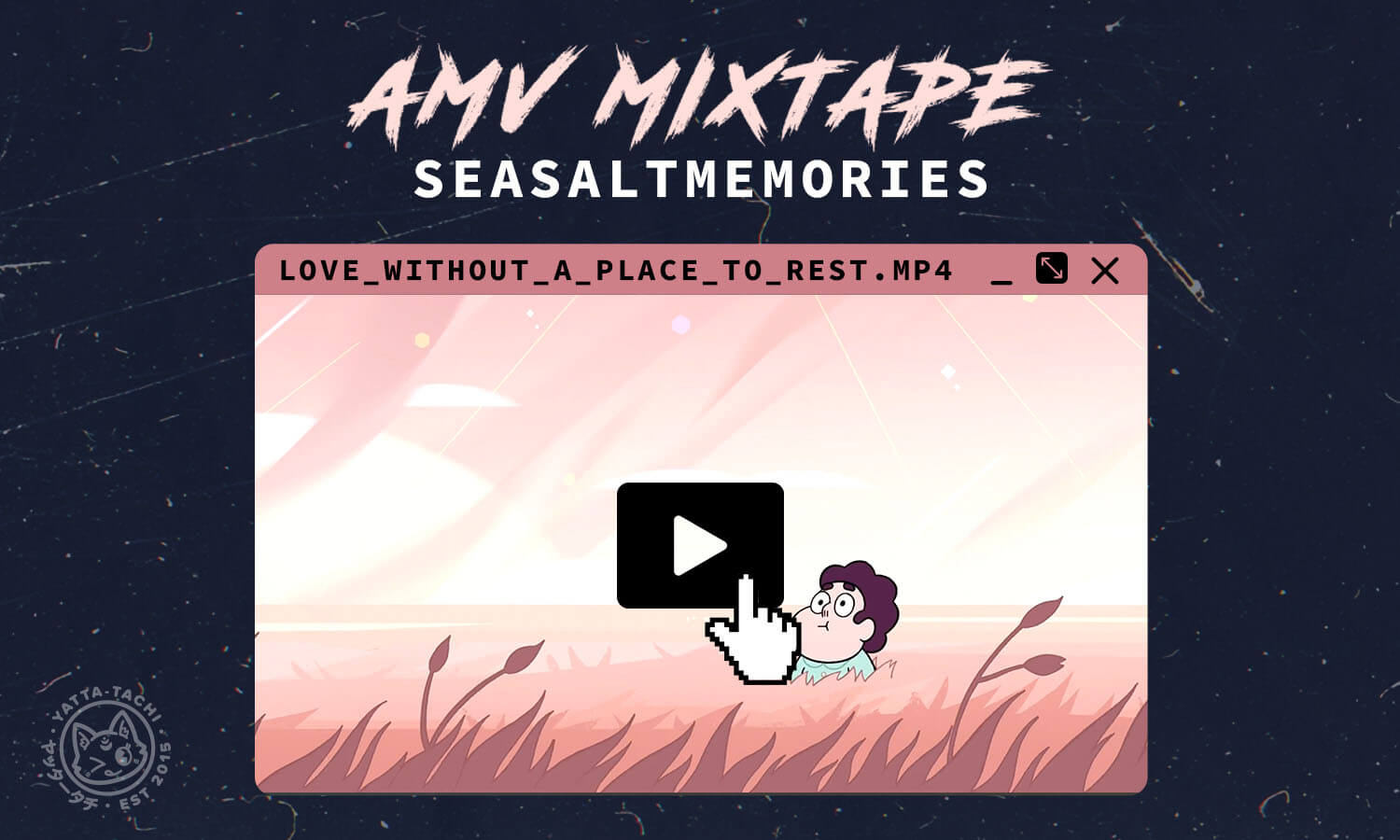
WESCOTT: Let’s move on to the next video, which is a Steven Universe AMV. I’m not as familiar with AMVs that use western cartoons as a source, but I’m sure they’re out there.
SEASALTMEMORIES: Editing with western animation is its own subculture. I’m less involved in that side of the community, although I have people in my life who keep me informed. But I was on board with Steven Universe early. It is near and dear to my heart.
WESCOTT: What was it in particular that made you latch onto it?
SEASALTMEMORIES: It wasn’t until I grew older that I realized what I was latching onto. But Steven Universe is great at making you sit with uncomfortable moments. Capturing the adolescent experience of seeing the adults in your life as people instead of guardians and caretakers.
WESCOTT: That’s my favorite part of the series, too. The gulf between Steven’s childlike view of the world and how that changes as he learns about the adult realities in the background. You can see the Utena influence in the footage you chose, as well.
SEASALTMEMORIES: Rebecca Sugar mentions being influenced by so many great shojo anime that I would later discover. It’s interesting to return and realize where the series came from.
WESCOTT: Is shojo anime and manga something you’ve always been into?
SEASALTMEMORIES: Not always. I’ve been a Princess Tutu fan for a long time. But then a friend sat me down to watch the anime remake of Fruits Basket. I thought it would be a fun, cute show, but it emotionally destroyed me! This was also before season 3 aired, so I was left wondering, “How are they doing to resolve this?!” That led me to rediscover shojo and josei, where I realized, “I’m very comfortable here.”
WESCOTT: The emotionality of Steven Universe is reminiscent of shojo manga for me. The tears, the intense expressions.
SEASALTMEMORIES: The flowers too. I don’t think these elements are unique to shojo, but shojo does it well. I like emotion-driven storytelling, where the focus is less plot or logic but expressing these feelings, illustrating a specific situation. I’d follow Sugar to wherever they do next.
WESCOTT: As for the VHS frame narrative, you wrote in the video’s description that it was due to lack of footage. Can you speak some more about that?
SEASALTMEMORIES: Steven Universe is told from his perspective, unless somebody is telling a story. Rose is a character whose presence is much larger than her overall screentime. So for the long instrumental breaks, I was wondering, “What am I even going to put there?” What I liked about the VHS structure was that this video isn’t as much about Rose herself as it is about Steven processing what he’s learning. A back and forth between her as the singer and him as the protagonist.
WESCOTT: Like “Love Like You.”
SEASALTMEMORIES: I remember slowly getting new bits of “Love Like You,” and how that transformed the meaning of the song.
Spring Awakening
WESCOTT: Let’s move on to “Spring Awakening,” which is a Bloom Into You AMV.
SEASALTMEMORIES: I got into Bloom Into You relatively recently. It’s a very grounded, sweet coming of age story, that for me as a queer woman gets to the relatable experience of being a teenager and figuring that stuff out.
WESCOTT: It’s too bad that the show never got a second season, because a lot of the best material in the manga really comes in the last few volumes.
SEASALTMEMORIES: Listen, if Yona of the Dawn can get a second season, anything’s possible. Give us more Bloom Into You!
WESCOTT: Watching the video, I was impressed by how much you get from hitting the beat at the right moment. Like with the train lights flashing on and off, plucking a petal from a flower, or the tide rolling in.
SEASALTMEMORIES: I have a background in dance. The music directs when you move and when you stop, which are both important. I take that attitude with editing as well, being aware of pace.
WESCOTT: The video’s also about the show’s two heroines and their respective gay awakenings.
SEASALTMEMORIES: The story is more complex because of Yu’s asexuality, and how that affects her relationship to love. But with this video, I wanted to focus on the terror and excitement that comes with realizing, “Oh, I experience things differently than everybody else. What does that mean for the rest of my life?” I also wanted to contrast Yu’s attraction to women with flowers and the natural world, and her repression with the train and other machines.
An attitude I have with editing is, “The song is queen.” Because people might be coming with no context, you want to prioritize what might be true to the song with what is true to the source. But I’m a fan, so I like taking the lyrics into account and adding them to the meaning. The song lyrics here say, “If you leave it alone, it will surely grow.” It’s trying to soothe, to offer acceptance.
WESCOTT: How do you come across songs for the AMVs that you make? Do you pick songs that you like and then think of a show to match it, or the other way around?
SEASALTMEMORIES: For the most part, songs I edit with are songs I like from artists I love. I start with a source, and then try to find a good song that works with it. If I can’t think of something right away, I’ll put it on a playlist called “edit one day” that’s thousands of songs long. If I ever need it, I can find it again.
WESCOTT: We’ll talk more about the MMVs you’ve made later. But for Bloom Into You fans, have you made any videos based on the manga?
SEASALTMEMORIES: There was a fun event I did with friends, a 5 hour MMV Iron Chef. That’s not a lot of time! I did do Bloom Into You, but I was assigned a song to use. I did try to use scenes from the latter half, because I didn’t get to use it last time.
Hymn of Eurydice
WESCOTT: I want to leave Aono-kun for last, so we’re jumping ahead to “Hymn of Eurydice,” which is based on Xenoblade 3. What got you started making videos using game footage?
SEASALTMEMORIES: While I’ve always been a fan of video games, finding sources for them is a lot more intensive. Usually you have to record the footage yourself, which is hard for a console gamer like me. Or you depend on the good graces of someone on the internet sharing their footage. Still, I feel more fond of the video game after I finish the video.
WESCOTT: Video games can be so long, even compared to anime. Especially a Kingdom Hearts or a Xenoblade. There are so many cutscenes spread over so many hours. That’s something that stood out to me about “Hymn of Eurydice.” You’re condensing a long game into this little diamond. I love Xenoblade 3, but it’s also all over the place, like many games directed by Tetsuya Takahashi.
SEASALTMEMORIES: My favorite Xenoblade game is Xenoblade X, which is the least traditional JRPG of them all. Like you said, they’re messy, they have a ton of backstory, theatricality, and big emotions. “Here’s an important thing that happened thousands of years ago!” You know, JPRG nonsense.
WESCOTT: On the other hand, one reason why “Hymn of Eurydice” works so well for me, aside from your skill as an editor, is that Xenoblade 3’s cutscenes actually have direction, like proper blocking and camera angles. Which is unusual for JRPGs these days!
SEASALTMEMORIES: One thing that can be tough with game editing is the difference between cutscenes and gameplay footage. Xenoblade 2 and 3, though, have fully animated battles in their cutscenes as well. I’ve also recently gone back and played Xenogears, as well as the first episode of Xenosaga. Those games also have excellent direction, even though you can tell the difference in graphics and technical output. There’s a love for visual language that echoes through it.
WESCOTT: Another thing I like about Xenoblade 3 is how much time you spend with the characters, since it gives you the whole party at the beginning. So I was happy that even though Noah, Mio and N are central to “Hymn of Eurydice,” you found time to include the rest of the cast as well, like Taion and Eunie.
SEASALTMEMORIES: Any JRPG is only as good as its party. Like you said, trying to condense everything took some finagling. But from the first verse, I thought, “I need to spotlight everybody.” It would feel unfair to the characters otherwise.
WESCOTT: Since you’ve been playing through the earlier Xeno games, do you have a sense for how N fits in with those other villains with evil split personalities?
SEASALTMEMORIES: Xenogears is the only one I’ve finished. You see a lot of repeated ideas, and different iterations on those ideas, with what the game was doing with Fei, Id, and Elly. That’s fun. I also think that Xenoblade loves picking the most miserable widower as the villain, like N and Jin. Men wrecked by losing someone.
WESCOTT: Are there other games you’d like to do videos for in the future?
SEASALTMEMORIES: I’m a big Fire Emblem fan. Though doing it would be hard, when there is so little footage. If I enjoy Fortune’s Weave and it has enough cutscenes, maybe. I’ve also had Fire Emblem Heroes, the gacha game, in the back of my mind, because it has so many images to borrow.
I was into Fire Emblem before Awakening. I haven’t played Path of Radiance, but I have played Radiant Dawn. I love Micaiah so much! She is my war crime girlie.
To Have Without Holding
WESCOTT: Alright, it’s time for I Want to Hold Aono-kun So Badly I Could Die. “To Have Without Holding” is not the first manga video that you’ve done. But I know you’re a big fan of Aono-kun, so…
SEASALTMEMORIES: I can’t turn down the chance to talk Aono-kun with people. I physically can’t.
WESCOTT: How did you first discover it?
SEASALTMEMORIES: Years ago I got laid off, which happens. While I was job searching, I found myself in the ghost romance niche to fill the time. I heard about Aono-kun while reading another series. Aono-kun was the best of them so far. It wormed itself into my brain and heart.
I realized it was special around the third or fourth volume when Yuri’s hair turns white and the story gets into her home life. You realize that these kids care about each other so much, but they’re in a horrible situation, and are not reacting well because of the environment that made them that way. It’s tender, sweet, and very sad.
I’ve reread it multiple times since then for different reasons. It’s great with prior knowledge, there’s a cohesiveness to it. On a second read I realized how deeply Aono loathes himself, and how prevalent that is from the beginning.
WESCOTT: Despite the fact that the character designs in the series are very simple, it’s impressive how much uncertainty and fear the artist can instill in a hand reaching from a doorway. Or a pair of giant feet.
SEASALTMEMORIES: For so long that was the only imagery we had of Aono’s mother. Even the detail of the pantyhose made it even more unsettling. While Aono-kun’s art is simple, it was able to communicate so much, and was so visceral. I wanted to take advantage of that.
WESCOTT: So you made a manga video, an MMV. Which is a format that’s been made alongside the AMV for a while now, but it’s not as common.
SEASALTMEMORIES: Anime and manga fandom overlap, so of course people would want to highlight the different mediums, especially if a series they loved was never animated or its adaptation never completed the story. But MMVs take a very different skillset. Any movement that happens in an MMV is because of the editor. There are very few happy accidents you can rely on.
To me, it’s the difference between tailoring a piece of clothing, making it fit in the way you want, and sculpting, where you have a block of wood and have to figure out what you want it to look like. They’re different skillsets, and they scratch different creative itches for me.
WESCOTT: Do you use Vegas Pro to make MMVs as well as AMVs?
SEASALTMEMORIES: I do use Vegas Pro, although it’s not the most powerful for MMV stuff. I know a lot of MMV editors these days who take advantage of the Adobe suite for what it can offer, especially animation-wise. None of this is to put down other people, there are so many out there doing cool MMVs right now. But at the moment, for what I want to achieve, Vegas covers it.
Bonus: Don’t Have Sex Or You Will Die and Get Pregnant
WESCOTT: Something else I noticed about “To Have Without Holding” is that it is laser focused on the main couple.
SEASALTMEMORIES: I love the side characters of Aono-kun as well. But it really is the story of the main couple and their relationship. To play with the title of the song I used, that’s where the heart of the narrative is. Yuri and Aono only know how to love each other based on the lack of love they’ve experienced in the past. What’s most interesting about the supernatural elements in the series is that we know that Aono wants the best for Yuri. He’s not a bad guy. But then, what does it mean when Dark Aono comes out?
WESCOTT: Reading the comic, I switched from believing Dark Aono was an intruder warping the real Aono’s behavior, to wondering if Aono always had this side to him from the start.
SEASALTMEMORIES: There’s a moment I love later in the series, where Aono forces Yuri to choose between him and their mutual friend Fujimoto. She says to him, “Stop sounding like Midori, my sister!” It’s such a cutting moment that shakes the both of them. Where did Aono get the idea that Yuri can only care about one person at a time? Why does he believe that?
WESCOTT: Going back through the shows we’ve discussed so far: Penguindrum’s about people who want to be part of a family. But what does that really mean? Is it something you should want? Then with Bloom Into You, the characters are trying to escape their boxes. Maybe there’s something similar here, where Yuri and Aono are in a kind of relationship they think they want, but then need to figure out what they actually want.
SEASALTMEMORIES: I like focusing on the sad ugly parts of people, but then seeing how those people try their best regardless of that. Sometimes your best is not good enough. But I think there’s a pathos that comes with self awareness when you try and get to that better place, or your true desire.
WESCOTT: It’s tough right now, because there’s terrible things happening around the world. So people are reluctant to engage with difficult material. But for many people I know, these kinds of stories are vital to engaging with the world around them, or understanding themselves. I’m glad there are people out there working through these hard feelings.
SEASALTMEMORIES: For me, it’s hard to get at real catharsis if you don’t grapple with those darker elements. I appreciate the emotional honesty.
WESCOTT: Do you think you might make more videos with Aono-kun in the future?
SEASALTMEMORIES: Well, there’s my shitpost, “Don’t Have Sex Or You Will Die and Get Pregnant.”
WESCOTT: I mean, real. That is what happens in the series!
SEASALTMEMORIES: I looked at the Japanese scans before the final volume got here, so I had an idea of how the story ends. I’m a fan of the ending. I thought it landed well. Now that I have the full thing, I have so many ideas.
Bookend
WESCOTT: At the end, I like to ask if there’s a recent video you’ve seen and would recommend.
SEASALTMEMORIES: I’ll recommend “Watching Through Water,” by Ophelia of Roseclipse AMV. It’s a great MMV for Our Dreams at Dusk. The way it’s able to get at the heart of a queer narrative of self discovery and acceptance, as well as its use of color and imagery from the manga, is just fantastic. I need to read the series. I have read Shonen Note, which is also by the same manga artist.
WESCOTT: I think you’d like Hiraeth: The End of the Journey, which is also by the same author. That’s a good one too.
SEASALTMEMORIES: So much manga, so little time. I just finished Gene Bride this week.
WESCOTT: I still need to finish that one! Anything else you’d like to pass along to our readers before we wrap up?
SEASALTMEMORIES: I encourage people to watch and read widely. A lot of my AMVs come from loving a series and wanting to share it with people. There’s so much good anime and manga out there that you might know nothing about.
Big thank you to our supporters
From their continous support, we are able to pay our team for their time and hard work on the site.
We have a Thank-You page dedicated to those who help us continue the work that we’ve been doing.
See our thank you page