Manga’s greatest strength is its breadth. There is a series for every subject matter that you can imagine, and an artist for every taste. Despite this fact, only a narrow slice of the medium has broken through abroad. That’s where MINT (Manga International Network Team) comes in. Founded in 2024, this organization champions six artists (and five editors) that each offer something unique through their manga.
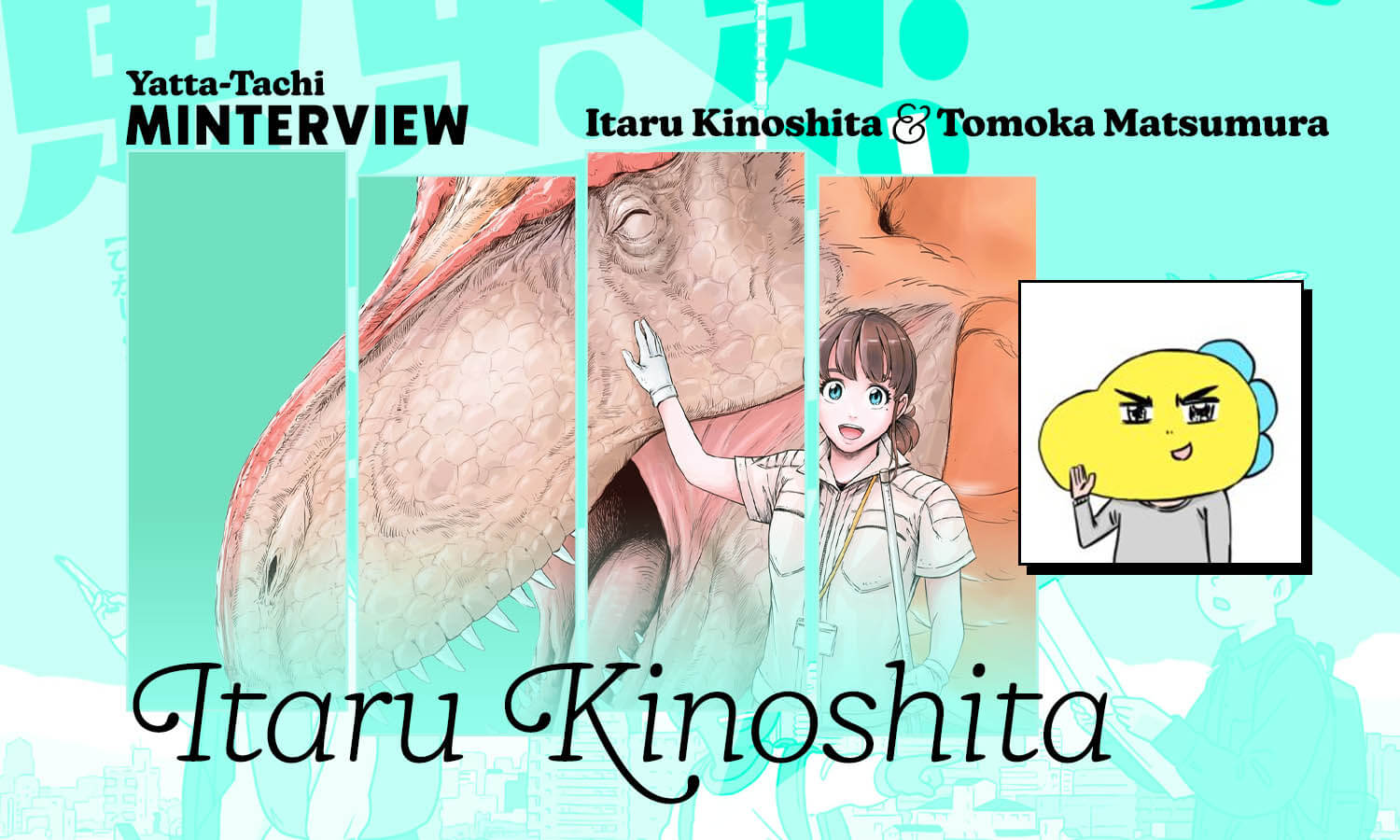
This is MINTERVIEW, a series of Yatta-Tachi interviews profiling manga artists and editors associated with MINT. This time we spoke with MINT affiliated artist Itaru Kinoshita and his affiliated editor Tomoka Matsumura. Kinoshita graduated from film school but chose to follow the path of the manga artist instead. His current series, Dinosaur Sanctuary, is a fan favorite for how it combines up-to-date scientific speculation (with the help of consultant and paleontologist Dr. Shin-ichi Fujiwara) with down-to-earth storytelling. His editor, Tomoka Matsumura, is a triceratops fan who works in BUNCH COMICS’s editorial department.
Itaru Kinoshita
As long as I can buy pen and paper
ADAM WESCOTT: When did you start reading manga, and when did you start writing it?
ITARU KINOSHITA: I started reading manga relatively late, around the fourth or fifth grade of elementary school. For some reason, we had CoroCoro Comic in our classroom—I think the teacher was buying it for us—and I liked Gakkyū-о̄ Yamazaki (Class King Yamazaki). It was also around the time volume 2 of One Piece came out. A friend had a copy and we used to pass it around so everyone could read it.
I began drawing manga in high school, trying to create a story to submit for Shonen Jump’s manga award, though I never managed to finish it. The first time I actually finished a work was three years after I graduated high school while I was taking a break from university. I submitted a story for Shonen Jump‘s Tezuka Award. I made it to the final selection stage but didn’t win anything. However, the comments I received from the judges Akira Toriyama and Masashi Kishimoto still encourage me to this day.
WESCOTT: As a graduate of San Francisco State University’s School of Cinema, what led you to move from making films to drawing manga? What part of filmmaking did you like best? Would you like to make films in the future?
KINOSHITA: I went to the US with the goal of becoming a film director, but I found the industry lacked a clear route for making that a reality—leaving me at a loss for what I should do. On top of that, filmmaking requires a lot of manpower and capital, so I found the idea of expending so much time and effort to turn the ideas in my head into a reality quite daunting at the time.
I mentioned it earlier, but having known the joy of manga from when I was applying for manga awards, I decided that I would adapt my manga for the big screen one day. For now though, as long as I can buy a pen and some paper, I can bring my stories to life. So I went down the path of becoming a manga artist.
Taking the long view
KINOSHITA: I shot a lot of movies for class and with my friends but what I loved the most was drawing storyboards and seeing them take shape during filming. It’s not a stretch to say I became a manga artist because I wanted to make movies. Of course, even now I haven’t given up on my dream of making movies and have ideas on how to do that, so I’m taking the long view.
WESCOTT: How did you make your debut as an artist? Did you work as an assistant, or did you start by publishing your own comics?
KINOSHITA: In 2018, I debuted as a manga artist with a release from Kodansha on the manga app “Comic Days.” I have zero experience as an assistant. I spent my days working part-time, entering stories for manga awards, and since I was assigned an editor I’ve been continuously submitting storyboards of my own work.
WESCOTT: How did you find your way to Palau in 2011? Were you able to swim in Jellyfish Lake (Ongeim’l Tketau)? If so, what was that like?
KINOSHITA: I was referred to a job opening for staff at a restaurant in Palau. This was right after I graduated university and had no money. The manga I had drawn while I was in university wasn’t really going anywhere, so I went there thinking that I could work part-time and think of ideas for a manga. In reality though, I didn’t have any days off and worked from morning ’til night so I barely had any down time. During the latter half of my stay, I managed to get some time off and went to the Rock Islands but didn’t get to go to Jellyfish Lake.
Living creatures just like us
WESCOTT: What are three facts you think that more people should know about dinosaurs that you learned while drawing Dinosaur Sanctuary?
KINOSHITA:
- Ideas about dinosaur behavior are ultimately inferences, not established facts.
- The dinosaur behavior I show in my manga too is ultimately classified as fiction. More than wanting to educate the reader, I simply want readers to enjoy the story.
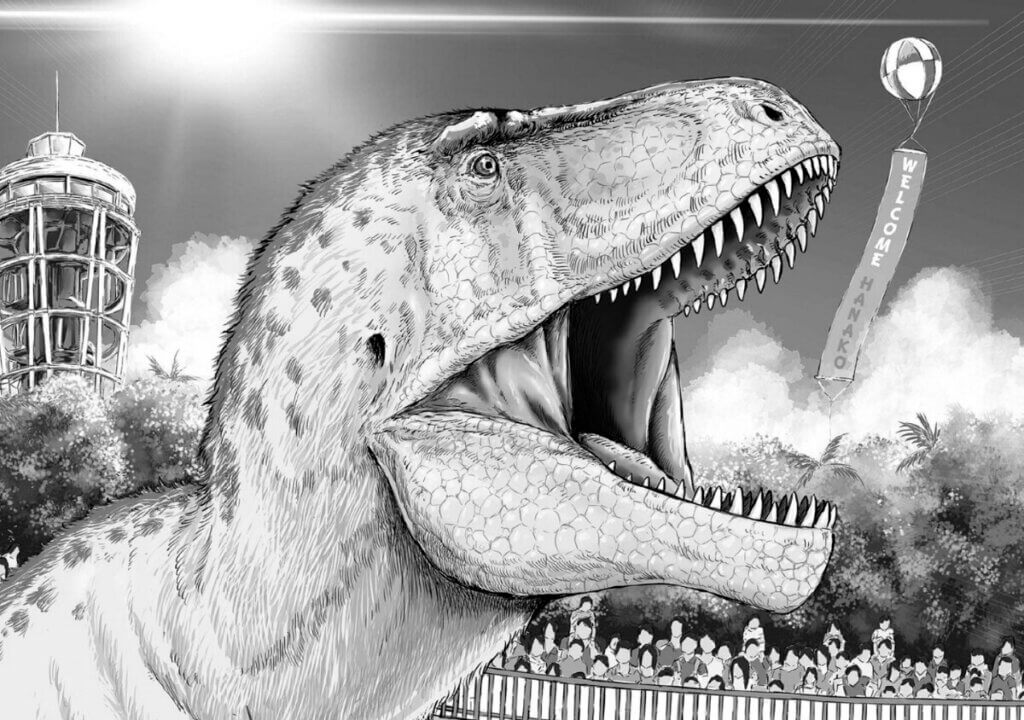
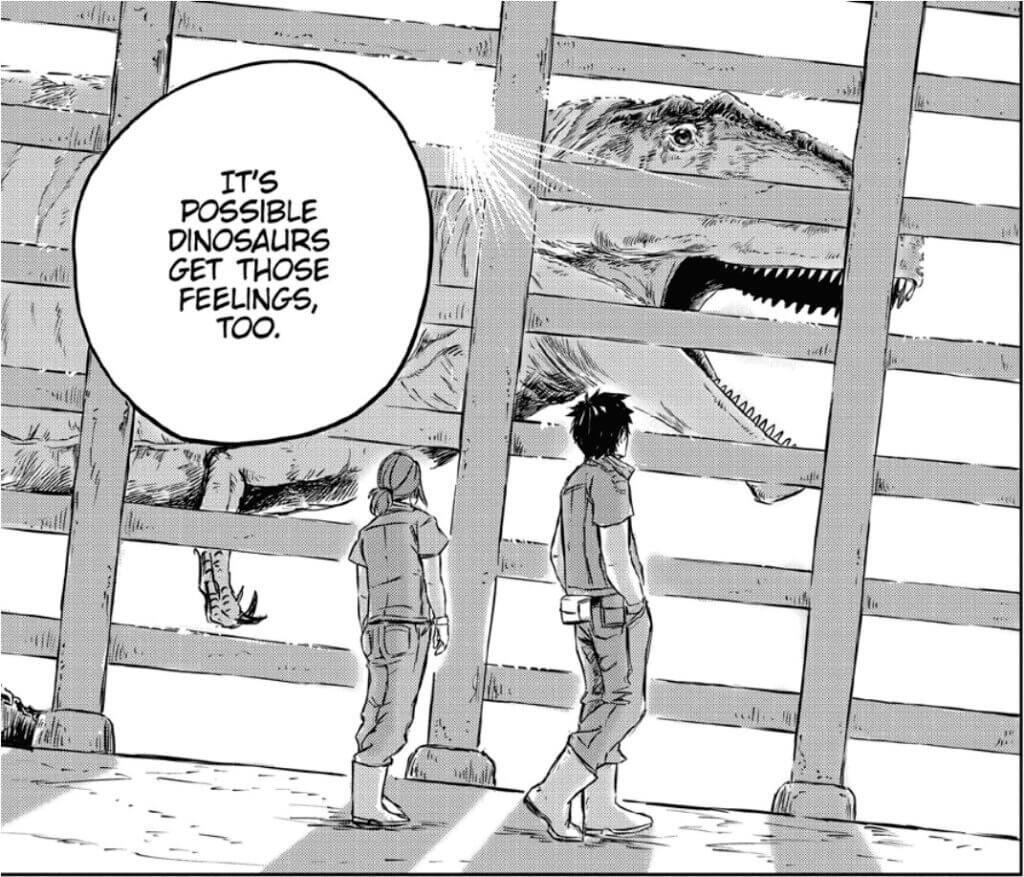
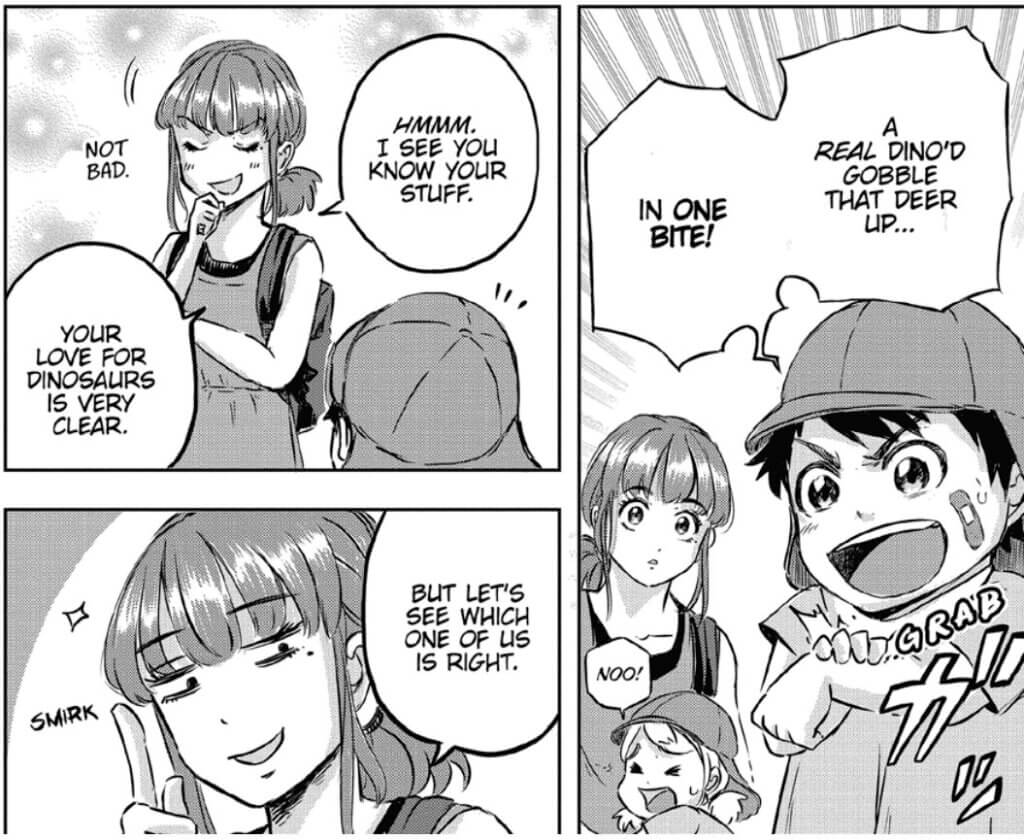
- That being said, if I had to single out one thing—which also happens to be the overarching theme of Dinosaur Sanctuary—it would be that “dinosaurs aren’t monsters, they’re living creatures just like us.”
WESCOTT: What are your favorite dinosaurs, and why?
KINOSHITA: Giganotosaurus and Psittacosaurus. I like Giganotosaurus simply because its shape is cool. And I like Psittacosaurus because of Fujiwara’s influence. Its round belly is cute and it’s particularly fun to draw since there are so many fossils of it.
WESCOTT: What made you choose to tell a story about a small, rather than large, dinosaur park?
KINOSHITA: It’s easier for the reader to feel a sense of familiarity with the imaginary world. It’s also set in Japan so a large dinosaur park wouldn’t be realistic given the geography and land area. My original concept was a dinosaur reserve with rangers but that story was set overseas.
A world that no one has ever seen
WESCOTT: What do you like most about drawing manga? What do you like least?
KINOSHITA: The thing I like the most is when I’m plotting out the story. Crafting a world that no one has ever seen brings me great joy.
The thing I like least is also when I’m plotting out the story. Putting in a lot of time and effort into it doesn’t necessarily mean you’ll get a good result. It’s super stressful and agonizing when you can’t think of any good ideas and the deadline is looming.
WESCOTT: Do you have any personal favorite tools or techniques that you use to draw manga?
KINOSHITA: I draw with an iPad, so it’s my favorite tool. My previous work was all analog, so in comparison I’m able to work much more efficiently now. Applying screentones, in particular, used to be nothing short of agonizing, so going digital has made that process a lot easier. However, nothing beats the simple joy of drawing with pen and paper.
WESCOTT: Do you have hobbies outside of drawing manga? If so, what are they?
KINOSHITA: I watch movies and read. Nowadays, I watch a lot of stuff via streaming services. It’s a huge help whether I’m in the middle of drawing or taking time off. If a book catches my eyes, I buy it right away even if I don’t read it immediately. I’ve bought and read so many books on dinosaurs over the past decade that combined with other things I’m interested in, there’s zero space left on my big bookshelf. Now I have multiple stacks of books on my desk like skyscrapers.
Tomoka Matsumura
I like triceratops because of Masaru
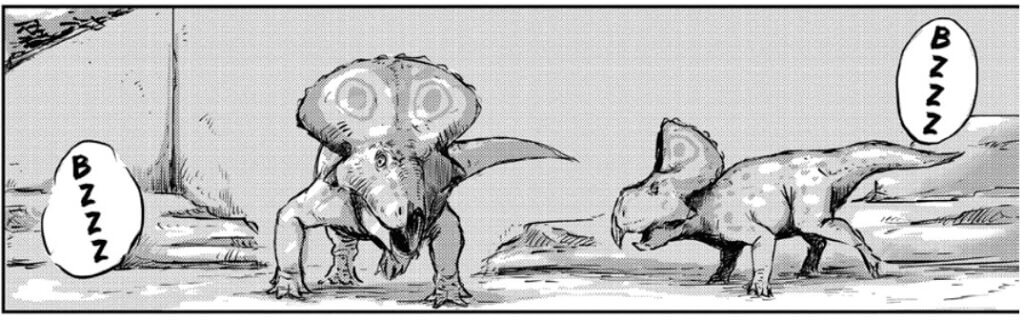
WESCOTT: You said in your profile that your favorite dinosaur is the triceratops. What about the triceratops do you like?
TOMOKA MATSUMURA: I like triceratops because of Masaru. There’s a scene in Dinosaur Sanctuary where he sits in a cat loaf pose. It’s super cute and I love it. His tucked-in front legs are especially cute.
WESCOTT: How did you first become involved with BUNCH COMICS?
MATSUMURA: I used to work in a completely unrelated field, but I’ve liked reading manga since I was young so I thought I’d like to work in a career related to manga. After working at a publisher doing administrative work and editing news sites and tabloids, I was able to realize my dream and became an editor for Shinchosha’s BUNCH COMICS in 2020.
Showing respect for everything
WESCOTT: When and how did you start working with Itaru Kinoshita?
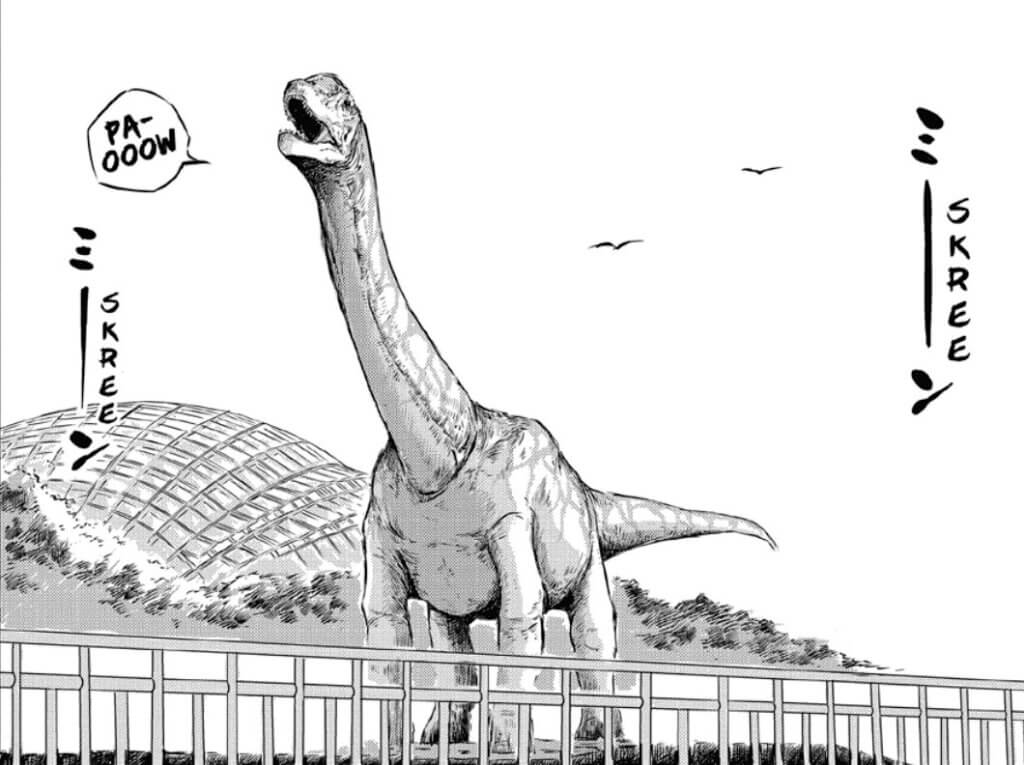
MATSUMURA: In early summer of 2020, Kinoshita brought what would become the basis for Dinosaur Sanctuary to BUNCH COMICS. I read it and thought it was fresh and entertaining. I contacted Kinoshita right afterward. We met and the two of us fleshed out the setting and characters through trial and error—repeatedly revising the storyboard after several meetings. In the end, the editorial department unanimously approved it for serialization and that is how Dinosaur Sanctuary came to be.
WESCOTT: What do you think is Itaru Kinoshita’s greatest strength as a manga artist?
MATSUMURA: I think it’s his ability to show respect for everything. His imagination, breadth of knowledge, and technical skills are certainly great, but he always treats everyone—starting with research consultant Shin-ichi Fujiwara—with respect. I think Dinosaur Sanctuary has turned out so great because he’s carefully considered the opinions of various individuals and was flexible enough to incorporate them.
WESCOTT: Where does Dinosaur Sanctuary fit within Itaru Kinoshita’s larger body of work?
MATSUMURA: Dinosaur Sanctuary is the world that Kinoshita wanted to bring to life for so long, so I think it holds a very special and important place for him. Even as he moves on to make new works in the future, Dinosaur Sanctuary will undoubtedly be his “starting point.”
Thank you to MINT for this opportunity! You can find out more about MINT, including a sample catalog of manga chapters drawn by the organization’s representative authors, at its official website.
Article edited by: Cynthia Caraturo
Big thank you to our supporters
From their continous support, we are able to pay our team for their time and hard work on the site.
We have a Thank-You page dedicated to those who help us continue the work that we’ve been doing.
See our thank you page