
Synopsis
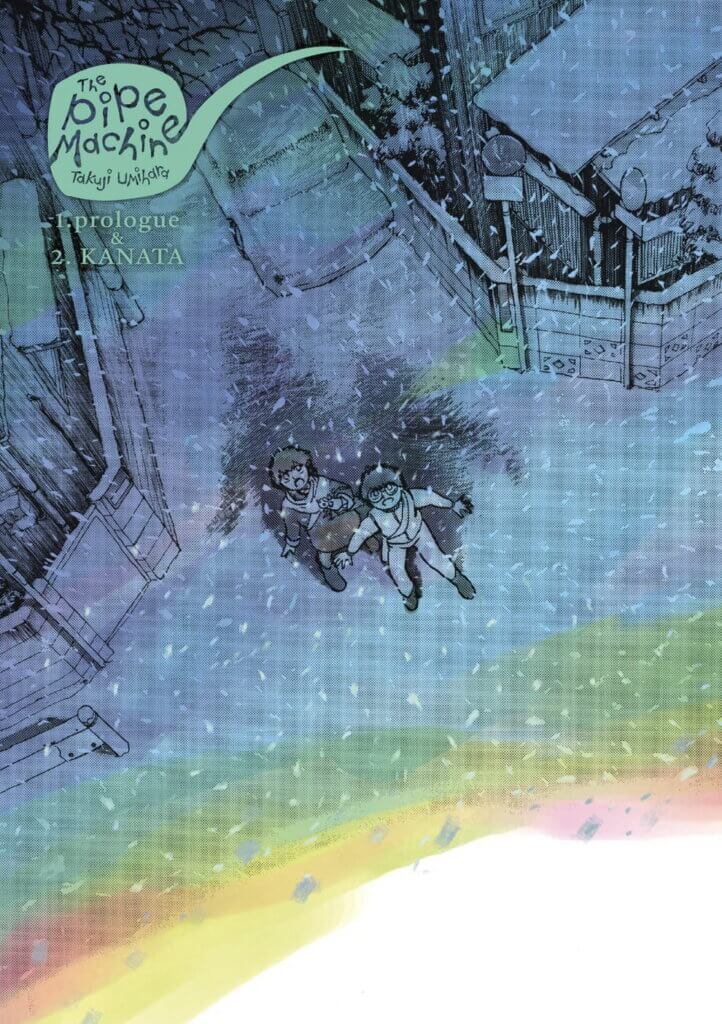
Saburo’s dad is a genius scientist who has spent his life trying to build a time machine. But now that he’s an old man, the best he’s been able to do is to build a big ship that looks like a pipe—and has no time travelling powers at all! That is, until a spaceship crashes in their house, revealing an ongoing interplanetary war between aliens fighting over pieces of the ultimate time machine. Now Saburo and his classmate Kyoko must adventure through time and space to save the universe. What awaits them at the end of their journey?
Tezukaphilia
The Pipe Machine is a throwback to classic manga and science fiction, which is always a risky maneuver. Don’t get me wrong, I grew up reading that stuff, and I have a soft spot for it. But when you build a work in dialogue with the past, you risk the reader asking themselves: why don’t I just go back and reread the classics instead?
What makes The Pipe Machine work for me is that it goes beyond replicating the surfaces of its influences to engage with deeper patterns and rhythms. One of artist Takuji Umihara’s favorite tricks is abruptly breaking the fourth wall for a gag in one panel before returning to normalcy in the next. It’s a weird maneuver that pulls the reader out of the reality of the story without much benefit—yet it’s also something that beloved manga artist Osamu Tezuka did all the time. By replicating techniques like these, Umihara captures the texture of those earlier comics without the need for explicit reference.
A classical sensibility
The book’s freewheeling narrative strengthens that classical sensibility. Major plot twists are introduced and undone within a few dozen pages. Science fiction conceits are hilariously blurry, presumably so that they can be reworked whenever Umihara chooses. The second volume of The Pipe Machine takes an abrupt turn into dystopian fiction, such that it might as well be a different series entirely.
It could also just be that the author is an enthusiastic amateur. In the volume’s Afterword Collection (which is worth the price of admission in itself), Umihara details his choices behind each twist and turn in the series. He writes, “It’s actually been a while since I read back over this, and it’s interesting how I was just drawing whatever came to mind at certain points.” You can tell!
Building his time machine
Umihara’s approach has its downsides. The book’s shifting status quo can make it tough to grab onto if you aren’t already on board for the ride. Other details, like the excessively-detailed “foreigner” who is the villain of the first volume, are just in bad taste. You don’t have to recreate Tezuka’s failures as well as his successes just to capture the essence of his comics.
The upshot is that Umihara is having a lot of fun building his time machine in real time. He can do complicated paneling across a double page spread. He can do cartoon pratfalls in blank white panels. He can do meticulously cross-shaded, sinister urban environments. Not every choice he makes works, and sometimes you’ll be hit with a facial expression that comes out badly or character blocking on the page that makes no sense. But the artist never lingers for long, and there’s always something new to see on the next page.
Unabashed pulp
The Pipe Machine, then, is pretty unique in terms of manga published in English. It’s not as polished as the kinds of comics published by Viz or Seven Seas. Nor does it have the earnest indie sensibilities of a Glacier Bay book. This is unabashed pulp by a guy whose greatest passion in life is clearly infodumping all about how much he loves Phoenix. (The back matter even says that he’s a blogger! Of course he is.)
I’m sure some folks out there might find that kind of guy insufferable. Me, though? I found The Pipe Machine to be a singularly blissful experience, and the most fun I’ve had reading a book from Manga Mavericks. It’s an homage to a genre I like by a hobbyist having the time of his life just drawing things on the page and seeing what happens. Not even what I think are mistakes are enough to detract from the book’s warmth.
Verdict
The strength of good amateur art is its tempo: the simple pleasure of “this happened, then that happened” set to a beat that does not quite match the market-tested strategies of mainstream publishers. These kinds of stories resonate because, no matter what we tell ourselves, any one of us has the freedom to make as much art (even bad art) as we wish. “I can do it too,” we say to ourselves after witnessing something that lights up our hearts. That is one of humanity’s greatest privileges, which we sacrifice at our peril.
As much as artist Takuji Umihara has skill and experience, his Pipe Machine belongs to the amateur press, rather than the mainstream manga industry. It is powered by Umihara’s self-indulgent whims rather than the needs of the market. Why bother, then? Because just as professionals have the resources to do things that amateurs can’t, there are tricks only amateurs have the luxury to pull off. Read this book, and I think you’ll understand.
You can purchase The Pipe Machine, Volumes 1-2 from the Manga Mavericks Books website.
If you liked The Pipe Machine Volumes 1-2, you may also like…
- Phoenix, by Osamu Tezuka
- Ex.Mag Vol 6, from various artists
- Robo Sapiens, by Toranosuke Shimada
Credits
Writer/Artist: Takuji Umihara
Translation: Dan Luffey
Lettering: Marcus Vinicius Ribeiro
Editing: Jan Mitsuko Cash
Cover & Logo Design: Darren Vogt
Prepress Technician: R. Gupta
Published in English by Manga Mavericks Books
Thank you to Manga Mavericks Books for providing a review copy. Receiving this copy had no effect on the reviewer’s opinions as expressed here.
Article edited by: Anne Estrada
Big thank you to our supporters
From their continous support, we are able to pay our team for their time and hard work on the site.
We have a Thank-You page dedicated to those who help us continue the work that we’ve been doing.
See our thank you page