Synopsis
Born and raised in the ancient land of Kemet, Merit is familiar with stories of the underworld. She knows that one day her heart will be placed on the scales, and weighed against the feather of truth. The jackal-headed god Anubis would then decide her fate: to either enter the Field of Reeds or be devoured by a crocodile god. Merit never could have expected that Anubis was a man her own age with dog ears and a bad attitude, or that he would leave her fate up to his underlings to decide. Not to mention that her first visit to the underworld would be while she was still alive?!
Anubis has fallen out of love with humanity, and given up on his duties. As punishment, the senior gods have cursed him to bear their appearance until he can get his act together. All hope seems lost until Merit falls into his life, and all his memories of the good in humanity come flooding back.
Beauty and the Beast for Monster Huggers
Were you ever disappointed that the Beast turned back into a human at the end of Beauty and the Beast? Did you start to question everything when you realized you found him more attractive as a beast? Well then, this is the manga for you.
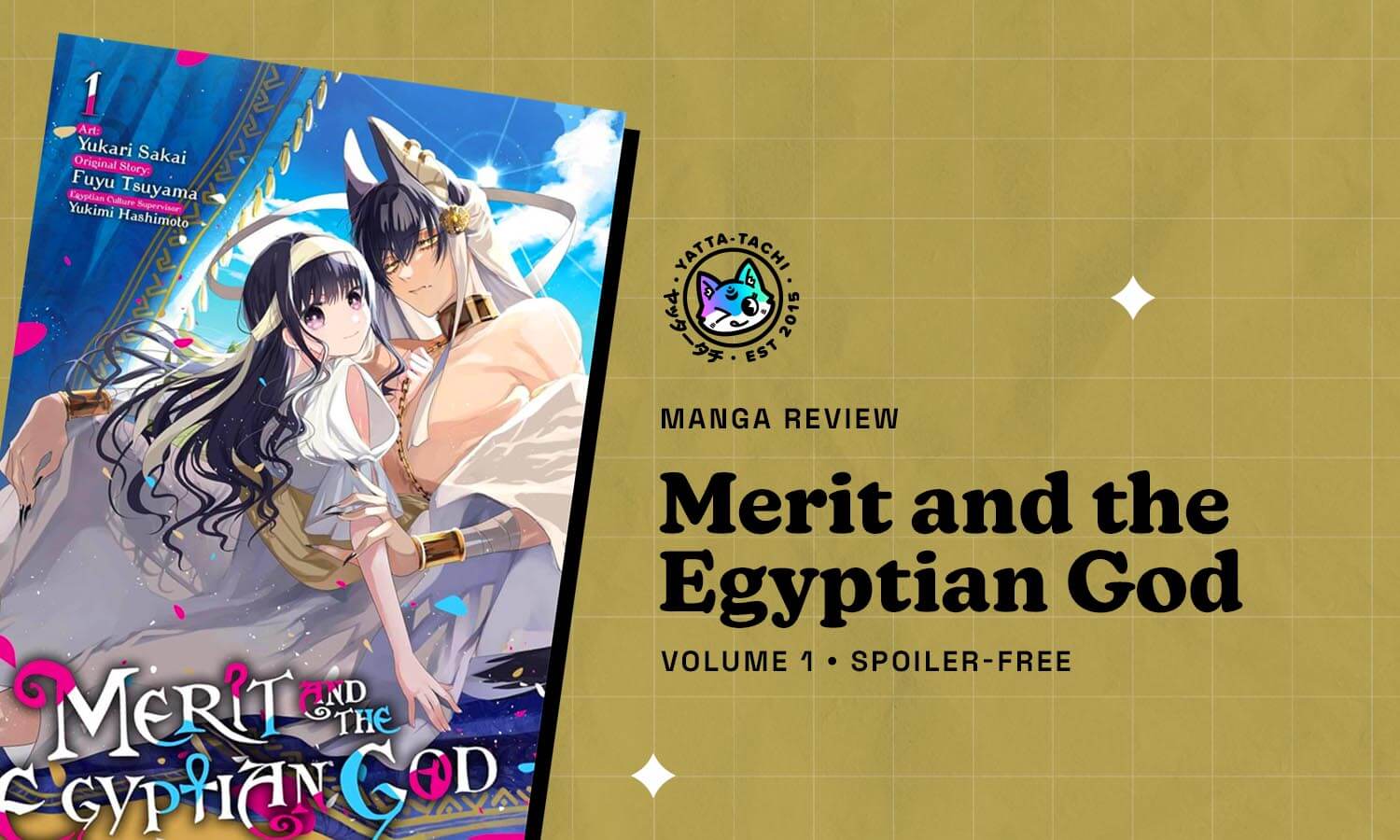
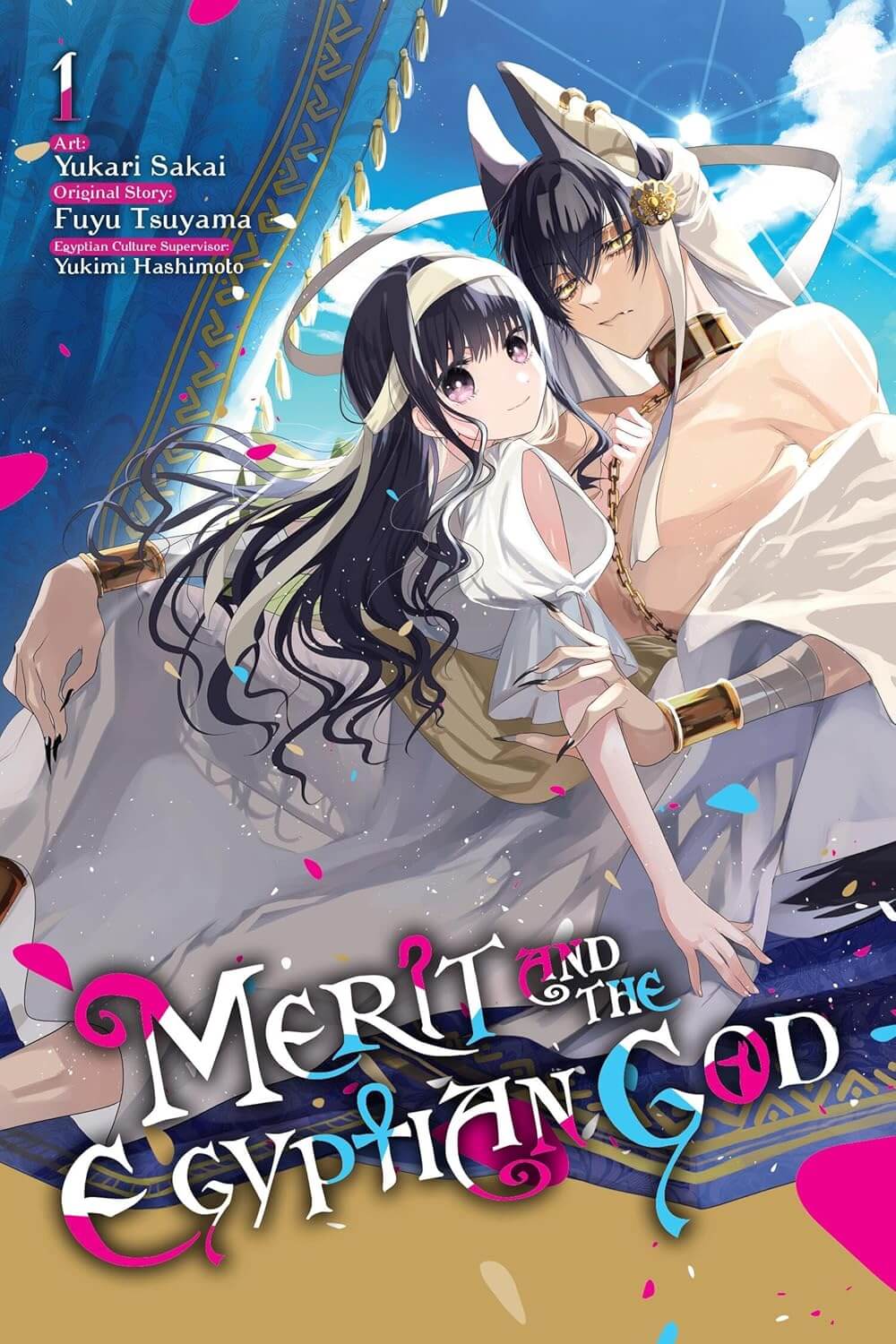
Anubis’ human form has an animal tail and ears. What makes the series refreshing is that his ultimate goal is to return to his jackal, rather than human, form. The love story element is perhaps not that comparable to the Disney movie, since Merit wants to befriend Anubis rather than avoid him. Anubis though reminds me of the Beast in that he is standoffish at first, and provides small gifts as a sign of affection. I can only hope for a generation defining dance scene in volume two.
Everybody Loves Egyptology
Merit and the Egyptian God is proof that the obsession with Ancient Egypt is a universal constant. While I don’t know the credentials of Egyptian Cultural Supervisor Yukimi Hashimoto, it is reassuring to know that the cultural elements are at least partly accurate. I enjoyed seeing the small elements that ground the series in its setting, such as hieroglyphics, carvings, and activities. I also got to learn some things about day-to-day life in Kemet.
I also loved the god designs, particularly Thoth. Their Ibis head makes them look beautiful and androgynous, whilst their characterization makes them both a great foil to Anubis and an ally to Merit. Amut’s design is also the perfect combination of terrifying and hilarious. Unfortunately the character designs fall apart the more human they are.
Pale is Stale
We can talk until the cows come home about the exact ethnic makeup of Ancient Egypt at any one time in its 3000 year history. The likelihood of everybody having pale skin with naturally straight hair, though, is unlikely. The faiyum portraits from Roman Egypt are a prime example of this variation in skin tone. While the characters might be wearing period-accurate clothes, their hair and skin are not period-accurate.
I see no reason why at least some of the Gods couldn’t have had dark skin in their human forms. It speaks to Japanese media’s innate colorism, just like how they portray bi-racial Haitian/Japanese tennis star Naomi Osaka as being pale skinned.
Merit and the Egyptian God is not the first to whitewash Ancient Egyptian culture. You’d think that by the 2020s, though, we would know better than to picture Cleopatra as Elizabeth Taylor. Other manga and manhwa series based on Ancient Egyptian mythology, such as Ennead, star characters with a variety of skin tones. Even the White American Saviour fuelled narrative of Stargate SG1 (1997-2007) hired Arab and North African actors to depict Ancient Egyptians.
The Hana to Yume Effect
Merit and the Egyptian God’s magazine Hana to Yume produced some of my favorite manga, such as Fruits Basket, Yona of the Dawn, and Kami-sama Kiss. But there’s no denying that their manga all fit a very specific aesthetic. Merit and the Egyptian God’s contemporaries, which include The failure at God School, Otaku Vampire’s Love Bite, and Tamon’s B-Side, all feature the same long haired, light skinned protagonists with conventionally attractive boyfriends.
In the case of Merit and the Egyptian God, the characters felt as if they were copy-pasted from other Hana To Yume manga from the 2000s, such as Fruits Basket and Yona of the Dawn. The plot itself reminded me of Kamisama Kiss, especially in the depiction of Merit as a can-do girl with a mission to befriend animalistic gods.
While these artists all tell unique and engaging stories, their visuals do not stand apart. It’s as though they’re all speaking the same language with different accents. AAVE, Geordie, and Cockney dialects might sound different but they’re all English. You see the same repetitive style format in other Shojo magazines like LaLa and Ribon.
Meanwhile, manga magazines that are aimed at a wider audience, such as the seinen magazines Morning Two (Witch Hat Atelier, Hiraeth: The End of the Journey, Saint Young Men) and Weekly Young (Akira, Boys Run the Riot, xxxHOLiC) publish series with distinct visual languages. Reading Merit and the Egyptian God reminded me of (an admittedly very good) doujinshi. Since they are targeting more than one demographic, they’re free to experiment more with how they draw rather than stick to what they know sells.
The book’s translators, Alethea and Athena Nibley, were also the original translators for Fruits Basket and Fruits Basket Another. At first I thought the similarities I noticed might have been their translation style. But I haven’t felt this way about their other work, such as D.N.Angel: New Edition or That Wolf Boy is Mine, even though they included similar themes and characters. If anything, the Nibleys’ translation helps modernize the series.I was particularly amused by their translation of “poi” (ぽい) as ‘Yeeet!’.
Heart on One Scale, Feather on the Other
I think that combining the classic Beauty and the Beast narrative with a journey into the underworld is a smart idea. There are so many underworld love stories that use the Persephone and Hades lens, and they’ve become dull and predictable in their abundance. I was happy to read an underworld love story utilizing a different mythology and love story trope.
Unfortunately, all these great ideas are dimmed by the colorism displayed in the character design. Once you’ve seen it, it’s hard to ignore, and each character reveal felt like a disappointment. It felt like such a lost opportunity for sensitive and accurate depiction of Egyptian people that fell victim to Hana To Yume’s aesthetic conformity.
At just two volumes, I still think it’s worth the time for fans of shojo manga. It encompasses everything that Hana to Yume has published over the years, while also serving as a great introduction for new readers.
For me, the scales weigh in favor of the heart. Merit and the Egyptian God deserves to live eternally in the Field of Reeds, rather than be devoured by Amut and forced into non-existence.
You can buy Merit and the Egyptian God Volume 1 from Amazon, Yen Press Store, Barnes & Noble, and Bookshop.
If you liked Merit and the Egyptian God you may also like…
- Colette Decides to Die by Alto Yukimura
- Star Crossed by Crimson Chains
- The Dragon King’s Imperial Wrath by Akiko Kawano and Aya Shikimi
Credits
Art: Yukari Sakai
Original Story: Fuyu Tsuyama
Egyptian Culture Supervisor: Yukimi Hashimoto
Translation: Alethea and Athena Nibley
Lettering: Lys Blakeslee
Published in English by Yen Press
Thank you to Yen Press for providing a review copy. Receiving this copy had no effect on the reviewer’s opinions as expressed here.
Article edited by: Adam Wescott
The Good
- Fun take on Beauty and the Beast
- Engaging Story
- Cool Egyptology Easter Eggs
The Bad
- Colorist design
- Unoriginal characters
Big thank you to our supporters
From their continous support, we are able to pay our team for their time and hard work on the site.
We have a Thank-You page dedicated to those who help us continue the work that we’ve been doing.
See our thank you page