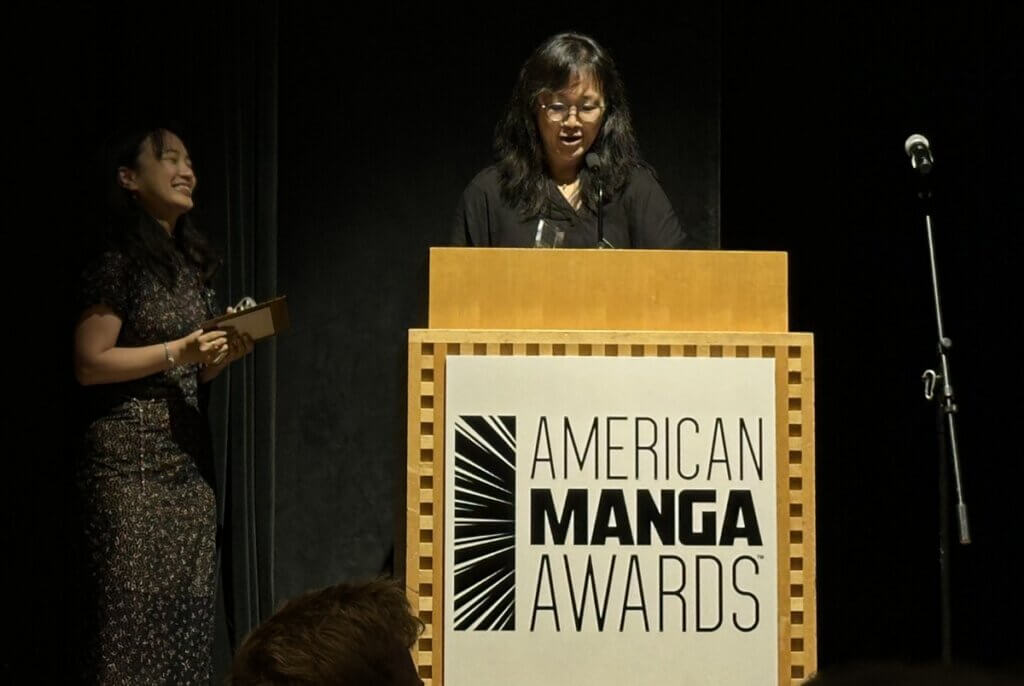
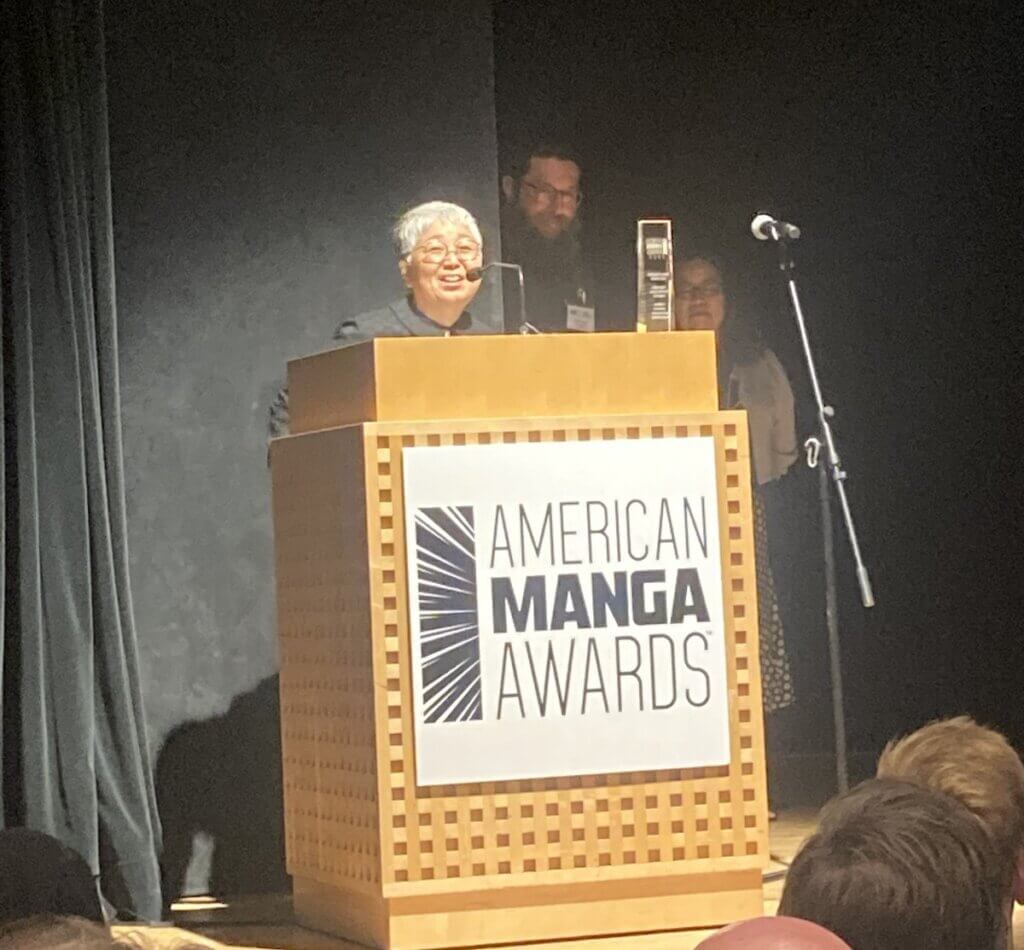
“To the three largest publishers of manga in the nation,” said Best Translation winner Jan Mitsuko Cash at the American Manga Awards, “please double your rates. For simulpubs, triple them!”
Commanding the stage of New York City’s Japan Society, surrounded by publishing industry professionals from both Japan, the United States, and Canada, Cash insisted on the importance of freelancers, who have no healthcare or retirement and live paycheck to paycheck working 80-hour weeks and are expected to pay monthly bills despite being paid every 60 days–if they’re lucky. “Freelancers are the foundation of your industry,” she said, “and that foundation is sagging.”
As rain pounded the streets of New York outside, the audience rose as one to greet Cash’s speech with a standing ovation. This is what this third annual American Manga Awards will be mostly remembered for–not the winners, the guests, or even the VTuber, but one person seizing the opportunity to say what was on everyone’s mind. When they write the history of the American manga industry in the 2020s, Cash’s words will be there, regardless of what happens next.
The bridge
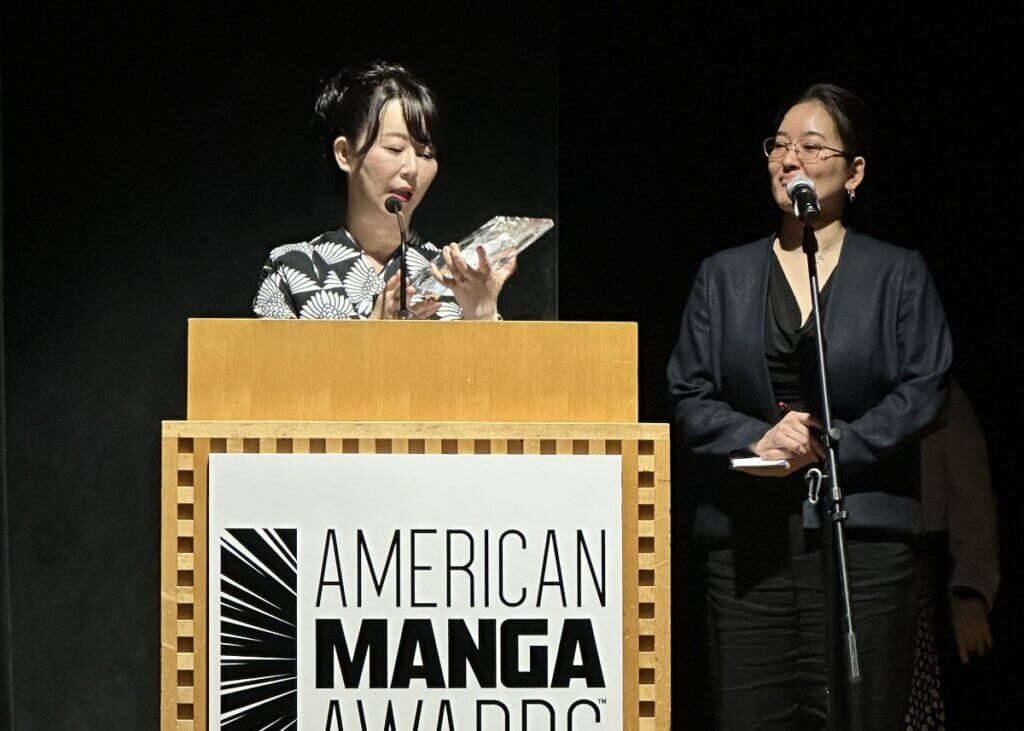
The American Manga Awards bridge the publishing industries in Japan and the United States. Last year they hosted the debut English release of Young Magazine while also recognizing affiliated artists Minetaro Mochizuki and Kengo Hanazawa. This year the Japan Society’s Director General Hiroyuki Kojima granted the publishing company Shueisha a special Centennial Award. As he said, “Shueisha has been a leading force in the Japanese publishing industry for a hundred years…when I spent a decade as a young person in rural Saitama, conversation at school revolved around Shonen Jump.” He gave the award to Shuhei Hosono, editorial director of Manga Plus, who took the opportunity to praise “the hard work of our manga artists and creators…and our readers.”
Also present at the ceremony was Akiko Higashimura, the artist behind beloved works like Princess Jellyfish; she was awarded the American Manga Award of Distinction. Presenter and committee member Deb Aoki emphasized that three previously untranslated works of hers were now available to read on Shueisha’s new website Manga Million. Yet she also made sure to mention that Higashimura isn’t just a manga artist–she runs a comedy club, dabbles in directing and writing live-action series, and has a show on NHK, all while keeping a strict 12-7 schedule. In this respect, the American Manga Awards shine a light not just on employees in the United States, but also on influential Japanese artists that the United States readership has yet to really understand.
Unsung heroes
What of the rest? As host and manga translator Zack Davisson said, the goal of the American Manga Awards is to celebrate “the people who are here, and the people who were too busy…” He meant this literally. One of the winners, letterer Madeleine Jose, couldn’t make it to accept her Best Lettering award for Maid to Skate. Her substitute, David Evelyn, nevertheless said that “it was an honor to work with Madeleine.” He then read Jose’s pre-written speech, which was devoted solely to thanking other members of her team. Wendy Chan, who won Best Publication Design for the recent Fruits Basket box set, did similarly.
The heart of the American Manga Awards, to me, is this process by which the United States manga industry’s “unsung heroes” speak up for each other on stage. Most will never win an Eisner award despite their hard work and expertise. This ceremony was created to remind us that yes, their work was essential, even though (said judge Amanda Chung) “it’s not an easy feat to live up to Japanese cover design,” or that (said judge Taylor Esposito) lettering is “one of the most overlooked parts of the comics-making process.”
This is where “honoring the United States manga industry” combines with “bridging publishing industries” in some fun ways. Wendy Chan was honored by a message from Fruits Basket artist Natsuki Takaya, who called Chan’s work “a treasure chest that brings the entire world of Fruits Basket together.” Maid to Skate artist Suzushiro also praised Jose’s lettering, saying that it had “elevated [my manga] into an even better work.” Not to mention Magica artist Yuzuko Hoshimi, who thanked Jan Mitsuko Cash for crafting an award-winning translation that would ensure their “story could reach the hearts of readers across the sea, in a different language and a different culture…”
Questions can lead to hope
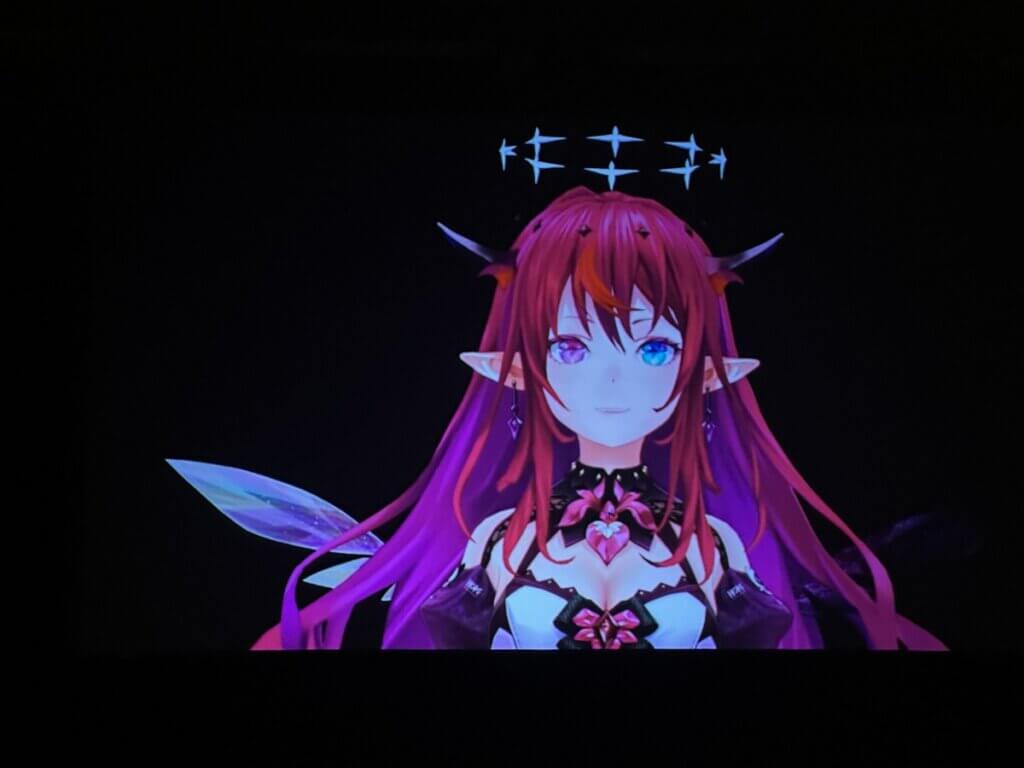
As for the other half of the awards, Best New Series went to Naoki Urasawa and Takashi Nagasaki’s Billy Bat, while Mokumokuren’s ever-popular The Summer Hikaru Died won Best Continuing Series. (The latter award was presented by the VTuber IRyS in one of the most surreal moments of the night.) Yuki Urushibara’s Mushishi won Best New Edition of Classic Manga, a worthy title that nevertheless filled me with dread. Is Mushishi really considered “classic manga,” now? (As my friend Justin from Comics Beat told me, “2000s manga is classic now! Get over it.”) I was overjoyed to see Machiko Kyo’s excellent book cocoon win Best One-Shot Manga, even if that meant awarding publishing giant VIZ a win over my favorite small manga publisher Glacier Bay Books. The Best One-Shot Manga category this year really was an outrageously strong selection of titles; I recommend buying and reading them all if you haven’t yet.
Machiko Kyo provided VIZ with a statement, which was as forthright and yet deceptively tricky as you’d expect from an artist like her. “I am both honored and deeply surprised to earn this award,” she wrote, noting that visiting Pearl Harbor taught her that Americans might not look kindly on her story of young Japanese nurses struggling to survive in Okinawa. Yet “throughout the 10 years since it came out, cocoon has never given up.” She also rejected labeling herself as an artist “doing the right thing,” recounting a time when she purged her garden of caterpillars in a fit of pique. Who would she be to judge another? cocoon in her opinion is not really a story about good and evil but instead one about questions, where “questions can lead to hope.”
Sheer force of will
The Hall of Fame section remains my favorite part of the ceremony. A mini-lecture positioned between awards for professionals and individual manga series, it’s an opportunity to hear the stories of influential individuals rarely acknowledged by fans. For instance, I learned this year that Hall of Fame winner Chigusa Ogino negotiated the rights via the Tuttle-Mori Agency to publish Dragon Ball in Spain in 1992. Later, she communicated artist Akira Toriyama’s message, via Shueisha, that if Germany wanted to publish the series, it would “have to publish in Japanese binding–or else!” Germany was therefore the first country to publish Japanese manga with Japanese right-to-left binding, years before Tokyopop marketed “100% Authentic Manga” in the United States. Ogino was also friends with legendary French comics artist Moebius and is even the subject of an upcoming graphic novel about her life to be published in France.
The other Hall of Fame winner was Ioannis Mentzas, co-founder of Vertical–the publishing company that was later purchased by Kodansha in 2011, and absorbed into Kodansha USA in 2020. “Ioannis dragged manga into the literary world through sheer force of will,” said presenter Daniel Joseph, noting how he recruited graphic designer Chip Kidd to design titles like Osamu Tezuka’s Buddha and Koji Suzuki’s horror novel Ring. “He didn’t care that nobody cared about manga. He busted his ass for 20 years to change that.” Despite co-founding Vertical, popularizing Tezuka’s weirder titles like MW and Ode to Kirihito, and even publishing novels nobody else would touch like Natsuhiko Kyogoku’s Summer of the Ubume, Ioannis’s name “isn’t even on” Kodansha USA’s Wikipedia page. (If he was never adequately recognized by the manga industry in his lifetime, at the end of it he at least earned the friendship of a colony of feral cats.)
Everybody on stage
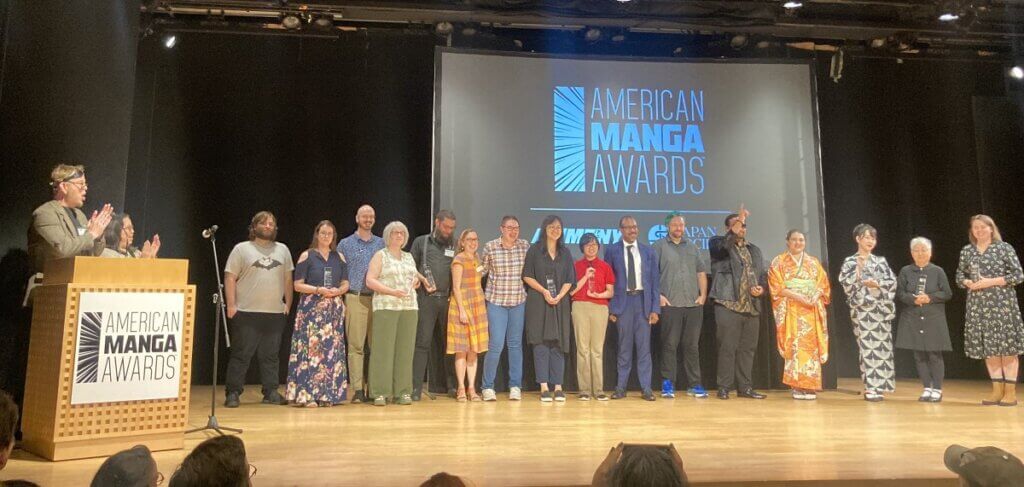
At the end of the ceremony, Deb Aoki requested that everybody in the audience who worked on a book that won go up on stage, not just the editors and individual winners. The ceremony therefore ended with a display of generosity, acknowledging that books are made not just by their editors but by a network of employees and freelancers conjuring magic from limited resources. That is the version of the United States publishing industry that gave Jan Mitsuko Cash’s speech a standing ovation.
Yet there is another side of that industry, represented by every time a presenter mispronounced the name of an award nominee; every time a nominee could not make it to the stage, because they were too busy working or could not afford to travel; every time a recipient of the ceremony’s Hall of Fame was acknowledged to have died young. Not to mention an early slide that miscredited the staff of the manga series A Cat is a Cat in Any Life, which was nominated for Best Publication Design.
That is the sagging foundation Cash criticized in her speech, the foundation that the American Manga Awards struggles every year to correct and yet cannot fully, because an awards ceremony can only do so much to solve an institutional problem. It’s nothing personal; the United States manga industry’s issues are just a more exaggerated version of what you see in mainstream publishing. But those problems are real, and they will intensify, unless the three biggest publishers (as Cash says, they know who they are) double, or triple, their rates.
Article edited by: Anne Estrada
Big thank you to our supporters
From their continous support, we are able to pay our team for their time and hard work on the site.
We have a Thank-You page dedicated to those who help us continue the work that we’ve been doing.
See our thank you page