
Synopsis
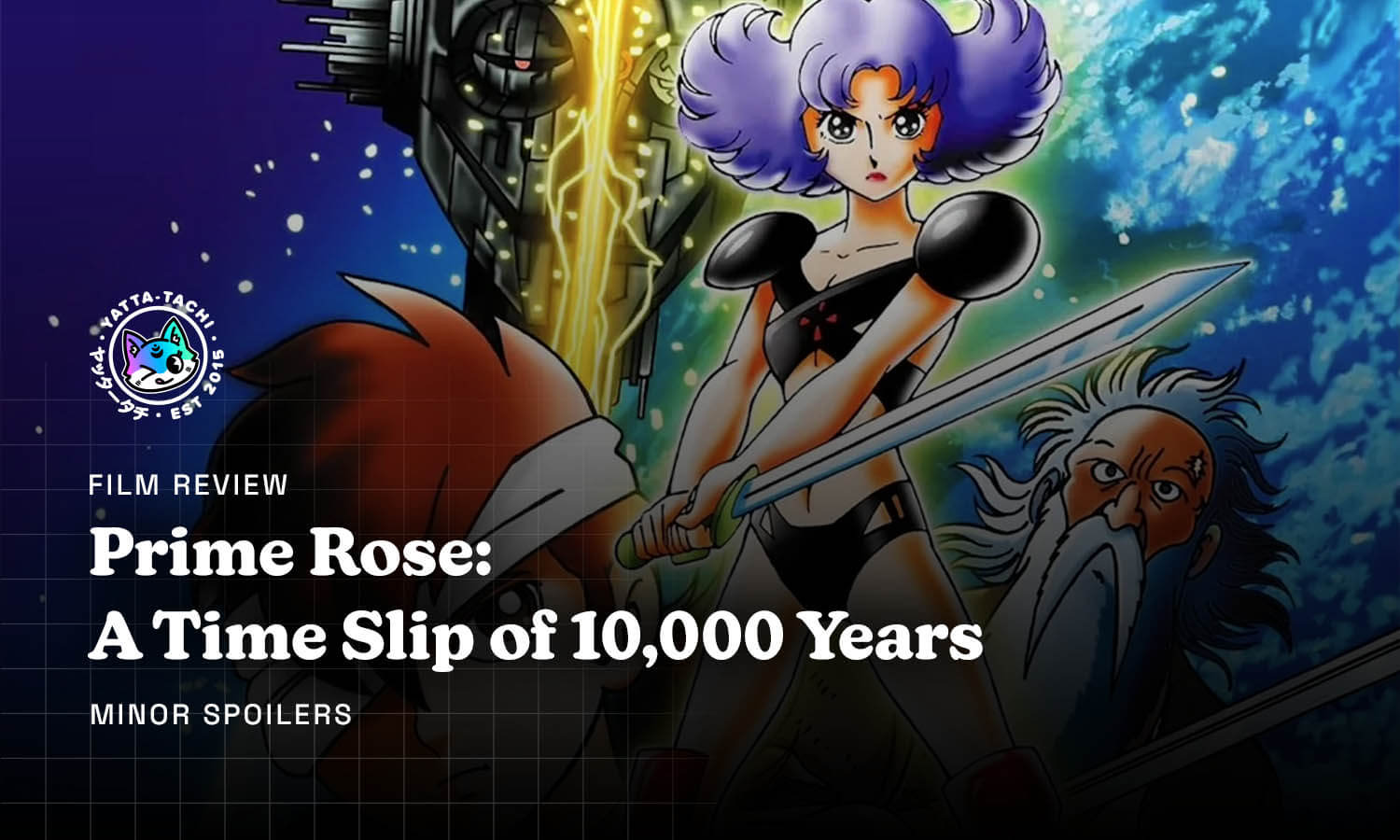
Prime Rose: A Time Slip of 10,000 Years is a 1983 feature film based on a manga by Osamu Tezuka and directed by Satoshi Dezaki (There Were Eleven). When a powerful entity hurls two cities on opposite sides of the world 10,000 years into the future, Gai Tanbara, a member of the Time Patrol, and his younger brother Bunretsu are sent to get to the bottom of what happened. There, they find the world in ruin, with both cities now locked in an eternal war with one another. Gai and Bunretsu stumble upon a labor camp and encounter Emiya Tachi, who is there to save her imprisoned lover. But her lover is murdered and Gai is captured, leaving Bunretsu and Emiya alone to find a way to free Gai and the other slaves.
Cities at War
Prime Rose: A Time Slip of 10,000 Years opens with a giant space satellite descending upon the earth, causing two nuclear-esque explosions that completely decimate two oddly-specific locations: Kujukuri City, Japan, and Dallas, Texas. For such an intense premise, the film’s opening and the scenes leading up to Gai and Bunretsu arriving in the future felt quite slow and lacked impact. The film then takes its time establishing what the world is like, depicting Gai and Bunretsu traveling through desolate landscapes and encountering a variety of fun creatures.
All the while, I found myself wondering when the titular Prime Rose would actually show up. It’s only after the pair stumble upon a labor camp where slaves are being forced to build numerous odd-looking statues that Prime Rose appears. At this point in the narrative she goes by Emiya Tachi, an unskilled girl who infultrates the labor camp in an attempt to save her lover. She not only fails at this, but Gai is captured, and she and Bunetsu escape alone. It is later revealed that Emiya is actually Prime Rose, the true queen of the imprisoned people, and she gains a newfound purpose: to train in the art of battle and save her people from subjugation. From here, the rest of the movie follows Emiya/Prime Rose’s journey to save her people alongside Gai’s quest to understand what happened to Kujukuri and Dallas.

Though Prime Rose is a sci-fi narrative, the blend of feudal futurism with fantasy creatures and Ancient Greek-esque cultural aesthetic doesn’t really read as sci-fi for much of the film. While there are cheeky nods to other popular sci-fi properties of the time, including Star Wars and Star Trek, this world leans much more towards fantasy sci-fi than the technologically-advanced sci-fi of the aforementioned properties. Notably, Emiya’s training is entirely sword-based and culminates in her battling against a fierce fire dragon.
If you didn’t know this was all taking place 10,000 years in the future, you could almost mistake it for Xena: Warrior Princess. It’s only very late in the film that significant sci-fi aspects of the narrative come to the forefront, but I appreciated the fun reveal surrounding the entity that brought the cities into the future, aka Death Mask, and the final battle. Speaking of the final battle… Maybe I wasn’t supposed to laugh, but the way Prime Rose utilizes her ability to turn to stone, which she receives after consuming the tongue of the felled fire dragon, made me completely lose it (in a good way).
Tezuka’s Time Slip
Tezuka was clearly trying to tap into a variety of things that were prevalent in pop culture at the time, including the aforementioned sci-fi properties and lolicon manga. When you’re not overly focused on how and why things happen as they do, there are pockets of enjoyment to be had, from the quirky critters to an oddly drawn-out court dance sequence. However, the narrative is inconsistent and overly complex, and characters are bland or, in the case of Bunretsu, downright infuriating.
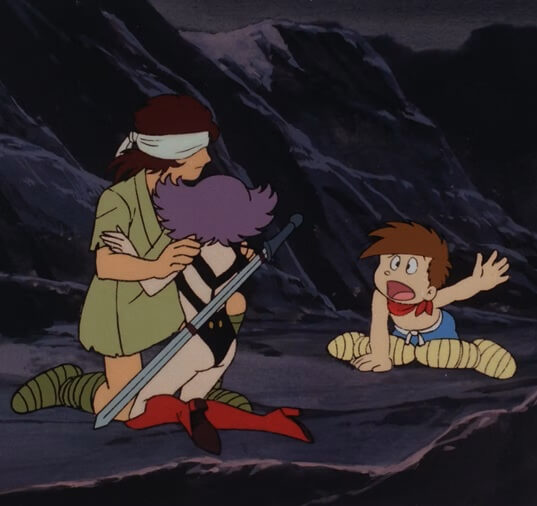
Moreover, there are a couple of aspects of the narrative that put me off in a major way, especially as someone who loves Princess Knight. Prime Rose is depicted as a strong character who takes up the sword to save the oppressed, but her extremely revealing clothing is completely out of place amongst the other men and women. It’s hard not to see the comparisons to Taarna from 1981’s Heavy Metal.
There’s also a whole scene where Bunretsu surprises Prime Rose when she is taking a bath in a desert oasis that clearly is only there as an excuse to show her topless. Furthermore, despite hardly ever interacting with Gai, by the end of the film, Prime Rose declares her love for him. I wanted to be excited about another butt-kicking female heroine from Tezuka, but Prime Rose falls into too many stereotypical tropes to be likeable.
It’s worth noting that Osamu Tezuka’s Princess Knight manga, in which Princess Sapphire presents as a male prince and dons a sword, came out in 1953, a whole 30 years prior to Prime Rose. Perhaps this is due to the different intended audiences—Tezuka apparently created Prime Rose as his attempt at lolicon manga, which was gaining popularity in Japan at the time. Still, it really turned me off to see Prime Rose depicted as she was. The character of Bunretsu is also completely insufferable and is constantly making lewd jokes, hitting on Prime Rose, or just being useless in general… I get that he was supposed to be the comedic relief, but I can’t imagine it being entertaining in 1983, let alone 2026.
Verdict
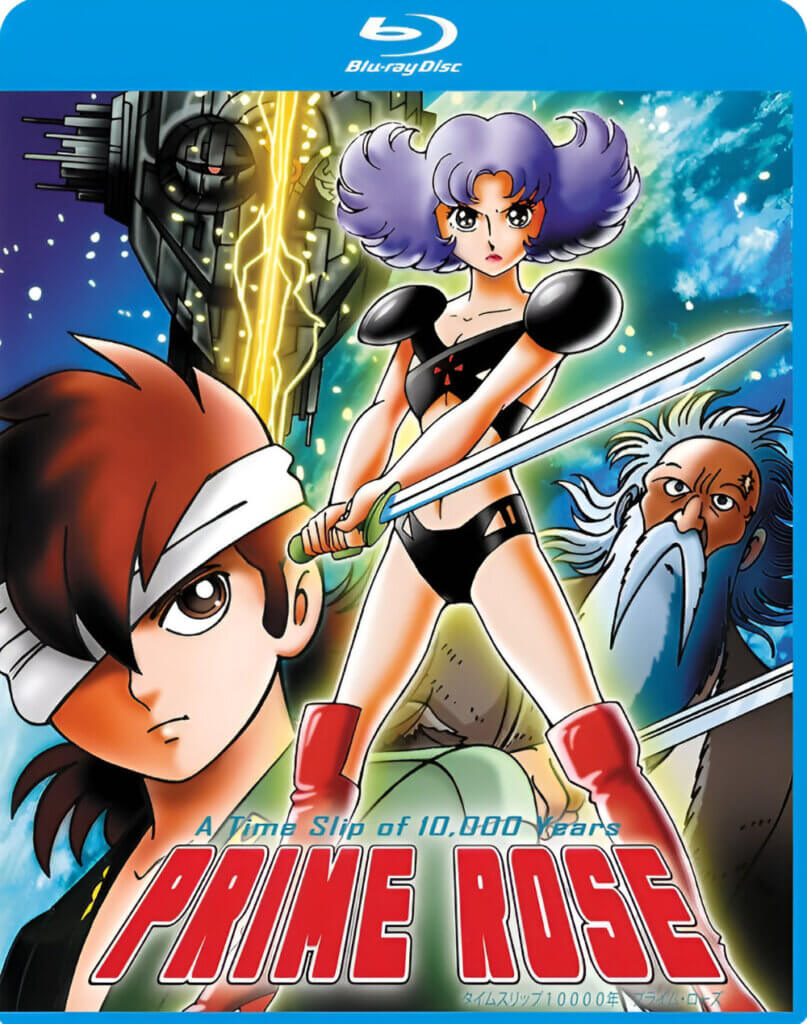
I was not able to evaluate the Prime Rose: A Time Slip of 10,000 Years Blu-ray features, such as the design sketch gallery, English cast interviews and commentary, and the new dub by SkySet Entertainment, as they were not provided with the digital screener. So, this review is based on the content of the film alone and does not take these aspects into account.
Due to the film’s mediocre sci-fi narrative, pacing issues, and overall inability to hold a candle to many of Osamu Tezuka’s other works, I would recommend it only to the most hardcore Tezuka fans.
Prime Rose: A Time Slip of 10,000 Years is available to purchase from MediaOCD.
If you liked Prime Rose: A Time Slip of 10,000 Years, you might also like…
- Princess Knight
- Nausicaä of the Valley of the Wind
- Heavy Metal
Credits
Director: Satoshi Dezaki
Screenplay: Keisuke Fujikawa
Producers: Takei Hidehiko, Dezaki Tetsu, Matsutani Takayuki
Music: Ono Yuji
Storyboards: Ishiguro Noboru
Original manga: Osamu Tezuka
Character designs: Osamu Tezuka
English Version Director: Phebe Fabacher
Engineer: Hayden Davis
Adaptation: Kym Rose
Timecodes: Ralph Villegas
Published in English by AnimEigo / Media OCD.
Thank you to AnimEigo / MediaOCD for providing a review copy. Receiving this copy did not affect the reviewer’s opinions as expressed here.
Article edited by: Cynthia Caraturo
Big thank you to our supporters
From their continous support, we are able to pay our team for their time and hard work on the site.
We have a Thank-You page dedicated to those who help us continue the work that we’ve been doing.
See our thank you page