
Synopsis
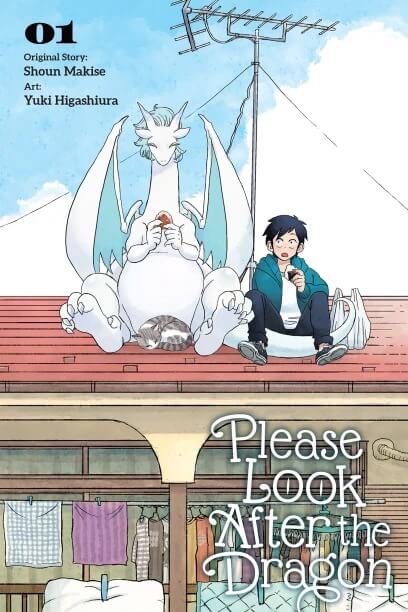
College student Murakami is walking through his neighbourhood one day when he comes across a dragon requesting help. The dragon, Islera, has just failed her magic exams, and fled through a portal to the human world before her disappointed parents could find out. While Murakami is reluctant to get involved at first, he soon finds himself with a magical creature for a roommate.
Crouching student, hidden dragon
I have a soft spot for the “reverse isekai” genre, which sees characters from fantasy worlds transported into the audience’s reality. Whereas isekai in the other direction tend to be power fantasies, these ones are fish-out-of-water comedies that explore how people from magical elsewheres would perceive things we consider “normal.” It gives you funny juxtapositions like the archetypal Demon King working in fast food, or an ancient willowy elf straight out of J.R.R. Tolkien getting addicted to video games. The Ghibli filmHowl’s Moving Castle did not, unfortunately, adapt the scene from the source novel where the characters step from their magical realm to modern-day Wales and have to wrap their minds around the concepts of TV and rugby, but I’m going to count it on this list regardless. It’s a fun genre space.
If you like all of that, you will probably likePlease Look After the Dragon. It’s cooking with familiar ingredients, and not necessarily bringing anything new to the table. But if you know you enjoy that flavour? Tuck in!
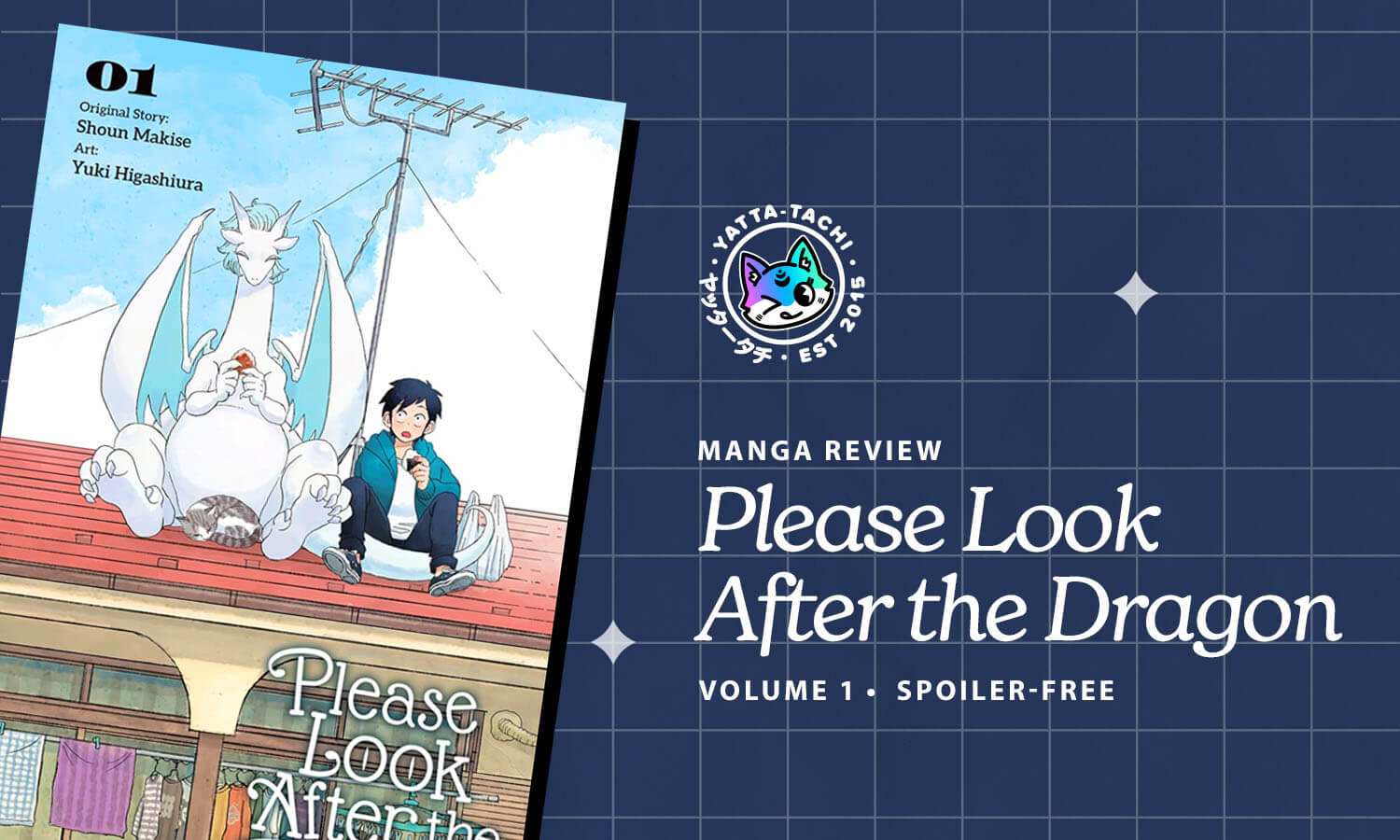
The art style works to emphasize the delightful study in contrasts at the heart of this genre, with Islera’s storybook aesthetic standing out against the straightforward realism of the suburban backdrops. Her elegant, wispy shape and long eyelashes are striking, and she has a regal, mystical air… naturally amping up the silliness when she inevitably does something elegant. Readers will get to feast on scenes of the “mighty” dragon shrinking herself to backpack size, going wild when she discovers delicious Japanese snack food, and semi-accidentally revitalizing a floundering shopping district when she uses her flame breath to make grilled onigiri.
Though Murakami becomes exasperated with Islera’s antics (more on that in a moment), he falls into a fun “odd couple” dynamic with her and is along for the ride. The humor is not always the most original or tactful; Islera frequently rages about people calling her fat, and her cover story to hide that she’s a dragon is convoluted. But what the heck, it’s cute and silly and doesn’t ask too much of the reader. Maybe that’s just what you want for a restful afternoon at home reading manga.
A bit of a drag(on)
Slice-of-life series live or die based on how much you enjoy watching the characters go about their everyday lives. Unfortunately, despite the fun premise, it’s the character department wherePlease Look After the Dragon started to lose me. Murakami is a generic protagonist, and I mean that both in the sense of “he’s fulfilling genre conventions” and “eh, this guy’s a bit bland, isn’t he?” He has a few stand-out traits, like his love for video games and his disdain for the fantasy trope of dragons taking human form, but he’s hardly three-dimensional. His main function is to be the capital-N Normal human in contrast to Islera’s supernatural hijinks. The artistic choices I noted above work to highlight this, too: Islera’s distinct look makes his stock-standard “guy with messy black hair” design even more dull by comparison.
Likewise, Islera embodies the high fantasy, high-maintenance opposite to average guy Murakami. She’s haughty and eccentric, a bit goofy, and causes problems when she tries to show off (though she does get to save the day sometimes, too) so that he can be comically frustrated in response. Her hiding in the human world because she flunked her magic exams is a funny punchline, but it could also be the bedrock of a character arc about her confidence and her relationship to dragon-kind. I hope the story explores this in more depth rather than just repeating the same gags.
Please Look After the Dragon is hitting the beats of a classic formula, and I can’t fault it for that. I can, however, tell you that it’s not really doing anythingbeyond that formula at this stage. By the end of the volume, the story is building a bigger ensemble cast of quirky humans and creatures, which runs the risk of piling on more and more characters instead of fleshing out the existing ones beyond their surface-level tropes. It’s not bad writing, per se, but it does threaten to get boring—which is a shame for a premise that involves something as fun and exciting as dragons!
The Verdict
Please Look After the Dragon won’t blow anyone away, but it’s a perfectly fine addition to a charming subgenre of fantasy. The character work could do with some fleshing out to evolve the main duo beyond their initial tropes, and the punchlines don’t always land with precision. But if you’re in the mood for a reverse isekai that hits all the fondly-remembered notes and all the comfortably familiar plot beats (and perhaps gives you a craving for dragon-grilled onigiri) this could serve you very well.
Please Look After the Dragon Volume 1 is available from Amazon, Barnes and Noble, Bookshop, and your local comic store
Credits
Story: Shoun Makise
Art: Yuki Higashura
Translation: Sarah Burch
Lettering: Elena Pizarro
English Publisher: Yen Press
Thank you to Yen Press for providing an advanced review copy of this manga. Receiving an advanced copy had no impact on the reviewer’s opinions.
Article edited by: Adam Wescott
Big thank you to our supporters
From their continous support, we are able to pay our team for their time and hard work on the site.
We have a Thank-You page dedicated to those who help us continue the work that we’ve been doing.
See our thank you page