

Content Warning: Emotional child abuse, trauma-related themes, homophobia
Where Spring Begins
Spring is often thought of as the season of new beginnings; snow melts, flowers bloom, and friendships form. For students of the all-girls Christian boarding school Saint Angraecum Academy, it marks the start of a new academic year.
And for Suoh Shirahane, the game’s shy, socially anxious, and incredibly smart protagonist, it is also a chance to properly attend school for the first time and make friends (or something more) like a normal teenage girl.
Flowers -Le volume sur printemps- is the first installment of a four part yuri visual novel series. Each game takes place over the course of a season, so the entire story takes place over the course of a year. A number of the characters introduced in the first installment appear across multiple games, as well, so this game is also largely an introduction to the longer saga.
A Garden in Full Bloom
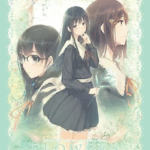
The entire time I played Flowers, -Le volume sur printemps- (hereafter, Printemps), all I could think was, “Wow, this game is gorgeous!” and, “There is no way it could get even more beautiful.” I was wrong.
From the very beginning, it is obvious how much attention went into making this game as stunning as possible. Going into a visual novel, one naturally expects the visuals to be strong, but Printemps still exceeded all of my expectations. The illustrations are beautiful, and I found myself lingering on them for as long as possible. I was also pleasantly surprised by how many there were; nearly every scene I wanted to see visualized ended up having a corresponding illustration. In the same vein, all of the characters are very lovely to look at. Each girl has a memorable and striking design. Everyone is just so pretty and cute!
Honoring its namesake, spring and flowers are incorporated in every design choice, from the vines around text boxes to the floral title cards. Many characters are also named after flowers. Since the piano is such an important motif in Suoh’s history, I appreciated how much the soundtrack makes use of it. I do wish there were more tracks, but the pieces that are included elevate the scenes wonderfully. That’s all to say, I think Printemps understands how to use its medium well. The illustrations feel just as important as the plot, and the overall sensory experience is elegant, immersive, and, yes, beautiful.
Suoh is also a darling main character. She is sweet and overthinks often, but is also incredibly brilliant. I especially enjoyed reading her deductions during the mystery segments. I love that, in addition to Suoh being a bookworm, Printemps constantly references other novels and films. I actually found myself wanting to search up some of the titles mentioned, and I ended up learning quite a bit.
I also appreciated that while romance and attraction are clearly present, that’s not what drives the story. Instead, Printemps is much more interested in the characters’ personal growth and desire to change. At first, I thought the game moved far too slowly, but I was surprised by how absorbed I became.
Like many visual novels, the majority of the experience is centered on reading, with occasional choices added in to push the player towards specific endings. While not heavily interactive, I think the incorporation of mystery arcs and having the player make deductions to solve cases made Printemps feel unique and engaging. One hour of gaming quickly turned into three. I came in expecting cute girls doing cute things, and while I did get that, I also found myself gasping more than once and sitting on the edge of my seat.
An Ode to Girlhood
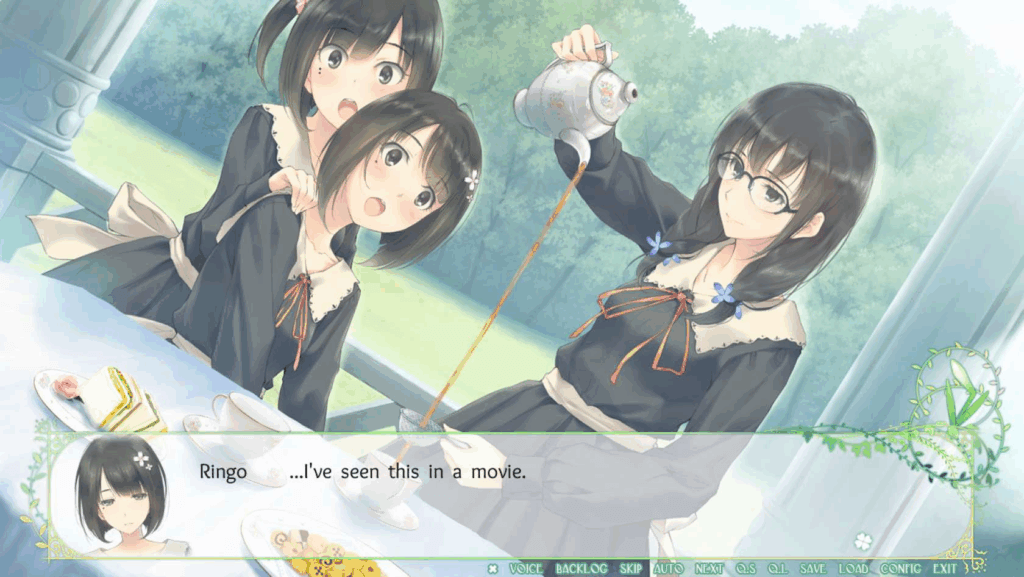
Perhaps the most relatable thing about Suoh is how often she thinks about how beautiful her classmates are. Such a mood!
One of my favorite parts of Printemps is how it explores different aspects of girlhood: first love, parental expectations, sexuality, and religion, to name a few. There are also many tangible expressions of girlhood: hairbrushing, tea parties, hugs and physical affection, helping one another get dressed, sharing beds, bathing together, and, of course, talking about horror and solving mysteries!
Most of the girls in Printemps are around 14, and even though they carry themselves with an air of elegance (with hobbies like piano, tea, baking, singing, etc.), they’re also awkward and a little clumsy in ways that feel relatable to the teenage experience.
When you think of yuri, you might immediately want to jump into romance. What I love about Printemps is that it is more interested in these girls confronting their feelings, such as pain, and deciding for themselves what they want their lives to be. So, if you are going in expecting a romance-first game, this may feel more indirect than you’d like. But I do think the game strikes a decent balance between friendship and love, the transience of adolescence, and the pain of one’s past. In all levels of intimacy, from platonic to romantic, there are hints of affection and care. Put simply: girls are wonderful!
Thorns Beneath the Petals
That being said, despite Printemps being labeled as a “mystery and yuri romance,” I found the mysteries to be the weakest part of the game. A number of the deductive questions can be answered by paying close attention to the text, but some require outside knowledge and research, which I feel could break one’s immersion or be unnecessarily challenging. (Personally, I used a guide when I didn’t know an answer… which was often.) And, while Suoh’s conjectures are fun to read, the cases themselves felt largely inconsequential. Some mysteries could be generously read as foreshadowing for the finale of the main ending, but most of them felt tacked on only so that the game could market itself as a mystery visual novel.
Surprisingly, I also thought the romance itself was on the weaker side. Mechanically, Printemps has two love interests, but it’s impossible to unlock the second route without completing the first one. In terms of writing, for a game that moved so slowly at first, I would’ve loved to see more time devoted to fleshing out how the romance developed. Rather than progressing naturally, it felt more like a switch turned on.
And, while I thought most of the voice acting in this game was great, the sound mixing for Suoh was disappointing. As a character, she is often shy and soft-spoken, but this also translated to her character being quite literally hard to hear during gameplay.
As mentioned in the content warnings, some of the characters in the game occasionally say casually homophobic things, such as variations of, “You know this is an all-girls school, right?” Because the game does explore characters questioning and accepting their sexuality, I didn’t find it completely off-putting, but I can imagine this rubbing some players the wrong way. There are also some awkward lines here and there, like the narration focusing on a character’s chest during an otherwise serious scene.
A Beautiful Beginning
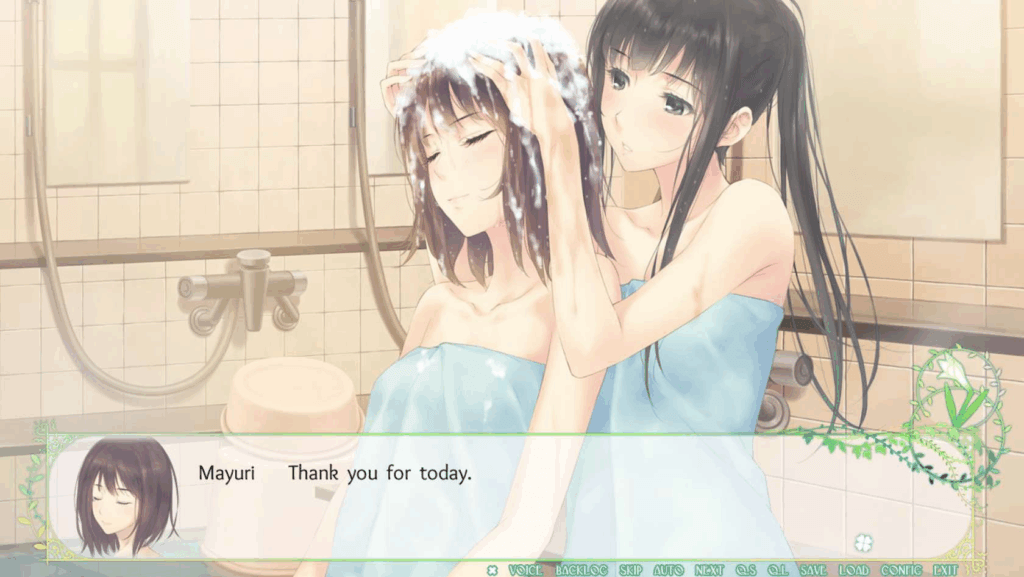
When a game is part of a larger series, I think the most important test is whether it makes you want to keep going, and Printemps absolutely does. As of now, I have only finished one route (Mayuri’s) and once I did, I had to pause and sit with my feelings. Even now, as I’m typing this, I’m trying to figure out when I can carve out time to play/read the rest of the series. I just need to know what happens next!
I should also mention that I’m terrible at solving mysteries, so I went into Printemps assuming I wouldn’t enjoy that aspect. While they ended up being the weakest part of the game for me, I still found them both interesting (since I got to play the part of a detective) and challenging (because they weren’t always straightforward). If you’re in the same boat, I recommend following guides.
Like many visual novels, Printemps has multiple good and bad endings. A lot of the time, I am perfectly content with playing a game once, but for the first time in a long while, I genuinely want to go back and see everything. For me to feel this invested–to want to play it again and again (once I recover)–I have to say Printemps is a successful game. I would especially recommend it to players who enjoy slow burns and stories about emotional growth. With the many literary references, I think bookish players would also find this lots of fun!
Despite its flaws, Flowers: Le volume sur printemps is wholesome, realistic, slightly traumatizing, and utterly stunning: an ode to all of the things that make girlhood and growing up both challenging and beautiful.
You can purchase Flowers -Le volume sur printemps– directly on JAST’s website or on Steam.
Thank you to JAST for providing the game key & sponsoring this review. Receiving this key & compensation had no effect on the reviewer’s opinions as expressed here.
Article edited by: Anne Estrada
The Good
- Absolutely gorgeous visuals and sound
- Compelling protagonist and character development
- Relatable depictions of girlhood
The Bad
- The mysteries feel underwhelming
- Romance could be developed better
- Occasionally off-putting language regarding sexuality
Big thank you to our supporters
From their continous support, we are able to pay our team for their time and hard work on the site.
We have a Thank-You page dedicated to those who help us continue the work that we’ve been doing.
See our thank you page