Content Warning: Non-consensual kissing, teenage girls fetishising male same-sex relationships
Synopsis
14-year-old Daisuke Niwa is not having the best of birthdays. His mum’s still making him do a deadly obstacle course just to get in the door, his crush rejected him outright for being too boring, and now his body is being taken over by a famous phantom thief whenever he thinks about her. Can a boy just not get a break?
It turns out that when the men of the Niwa clan turn fourteen, something awakens in their D.N.A, and they become one with the legendary phantom thief Dark. Now, whenever Daisuke thinks about the girl he loves, Dark takes over his body and he transforms! All Dark wants to do is steal priceless works of art, flirt with girls, and cause major problems for Daisuke’s social life. However, if they both hope to be free from this curse, they’re going to have to learn to work together!
Ultimate Shojo
D.N.Angel is a quintessential late 90s/early 00s shojo. It’s a wacky, character-driven romance which uses magical transformations as a loose metaphor for puberty. There’s even an adorable, fluffy sidekick who helps get the hero out of trouble by getting him into even more trouble. Whilst the main character is a boy, there’s still a good range of female characters. Twin sisters Risa and Riku reject the common trope in manga that identical twins are interchangeable beings, with Daisuke and Dark’s differing feelings towards them being a major plot point. Daisuke’s mum is a classic MILF, too, and a criminal mastermind in a flowery apron who has been let down by the whole “only men can become Dark” nonsense.
The romance connections in this story require a pinboard to work out. Daisuke likes Risa, but Risa likes Dark; Dark likes Riku, but Riku hates Dark and is in love with Daisuke. Then there’s the fact that Daisuke’s mum had a crush on Dark as a teen, but now sees him as her son. And then there’s the mysterious silver-haired Hiwatari, the teenage detective, who is a little too quick to give CPR and has an interest in Daisuke that goes beyond the professional. As the manga continues, I promise it will get even more complicated. This may be a turn-off for some who seek out simple and straightforward non-problematic relationships. However, if you love messy drama and are willing to overlook a couple of turn-of-the-millennium tropes, you’ll find yourself having an absolute ball!
But the connective tissue throughout the whole story is the relationship between Daisuke and Dark. The two are distinct beings, with their own personalities and appearances, but still have to live within the same main body, even if they can shapeshift. However, by taking the time to (literally) walk in each other’s shoes, and see the world from (literal) new perspectives, they both come to better understand themselves. Daisuke brings out the kindness in Dark, and Dark brings out the confidence in Daisuke. The puberty metaphor shines here, as the manga delves into not being afraid to grow and change as you enter your adult life whilst still figuring out what it is that makes you you.
Heists Gone Wrong
The gentleman thief trope is a well-loved one, from Raffles to Lupin III to Ocean’s 8, heist stories being a favourite from generation to generation. D.N.Angel tries to tap into this trope with Dark being a phantom art thief who only steals specific works of art, and maybe a few hearts. On the surface, Sugisaki succeeds at this. Dark is absolutely the kind of bad boy goth teenagers have been lusting over ever since Lord Byron put pen to paper. However, aesthetics can only get you so far. When it comes to the actual heist elements, D.N.Angel starts to fall apart. They’re glossed over rather quickly, with little to no explanation about how the artwork was stolen. Unfortunately, there’s a lot of build up with no reward.
On the whole, the story is more focused on the relationships between the characters, than any overarching plot. Whilst there’s plenty of mystery and intrigue with regards to the connection between Daisuke/Dark and Hiwatari, it doesn’t expand to anything approaching the level of action/adventure one might expect from such a title.
The Return of an Icon
D.N.Angel has been plagued by excruciating hiatuses and folding publishers. The manga was first published in Japan in 1997, but wasn’t finished until 2020. For English readers, it’s been even worse. After Tokyopop closed its American Publishing arm in 2011, fans were left on a total cliffhanger. Many thought that this series would never be published in English again! So, when Yen Press announced back in April that they were going to publish the new edition, shojo fans (myself included) went absolutely buck wild.
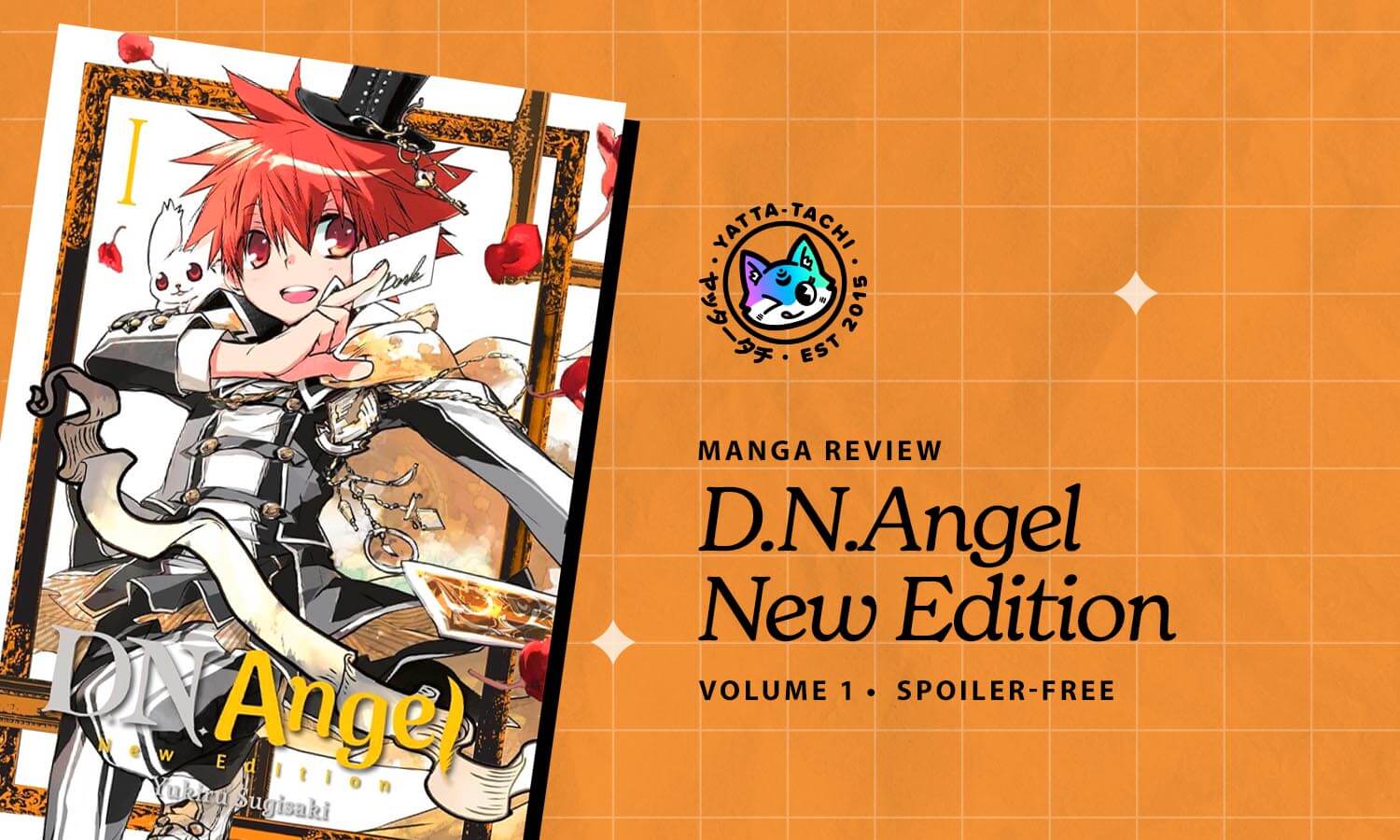
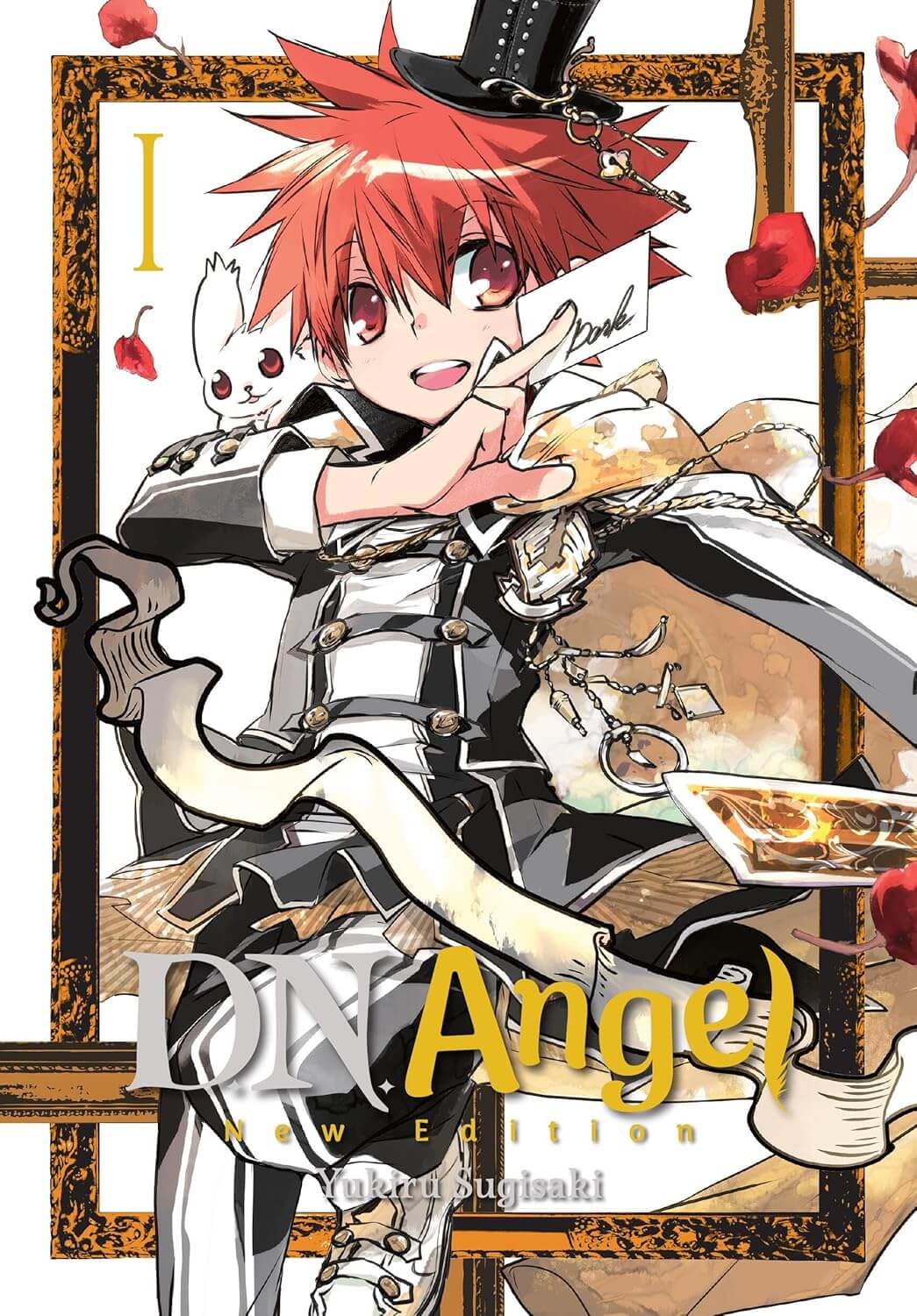
New Edition contains two volumes of the original 20-part series. They have brand-new covers, and are filled with full colour illustrations throughout, making it perfect for collectors. The original Tokyopop edition was translated by Alethea and Athena Nibley, and this dynamic duo have returned to bring a fresh new translation. I love the Nibleys’ work, from the original Fruits Basket to the brand new Sailor Moon – these two are the queens of shojo translation. With their decades of experience and history with the series, fans can rest assured that this manga is safe with them.
It’s a little disappointing to see that New Edition doesn’t contain any of Sugisaki’s short stories, since they’re a great edition to the series to see their evolution and influences as a creator. However, it’s not uncommon for these to be omitted from omnibus editions in Japan. I can understand wanting to streamline the series by focussing on just one story, however it is still sad to lose them.
Comparing this 2025 publication with my original 2004 copy really shows how much the industry has improved when it comes to layouts. In the original Tokyopop copy, the sound effects were left completely untranslated, often to the detriment of the story. Here, letterer Chiho Christie has done a decent job of matching type faces with the originals. It feels a lot more seamless than the original English version by far! There are a wide range of typefaces used throughout the book, which matches the approach of the original Japanese. This gives the page a fun, youthful feel that adds to the nostalgia hit.
However, there were some choices that I really did not like, mainly the use of Broadway-style fronts. I find that family of typefaces difficult to read due to the stark contrast of line weights. When blown up for a poster, fonts like Broadache work fine, however when reduced to the size used for manga, it becomes almost unreadable. If it was used in a background sign or subtitle, it would be fine. However, when used for an important speech, I have to try and decipher what is being said, which completely takes me out of the manga. There are only a couple of examples of this typeface being used, but given that it’s quite inaccessible from the perspective of both those who are visually impaired and those with learning disabilities, I still feel as though it is worth mentioning.
Final Thoughts
It feels as though we’re in a bit of a Shojo Renaissance at the moment. We’re seeing more classic series getting published by a plethora of different publishers. We’re no longer having to wait years between a series getting published in Japan and arriving on our own shelves. Series like Magical Girl Dandelion and The Kings Beast have even gotten simulpubbed by Viz Media in the same way they publish Shonen Jump titles. Your favourite shojo getting an anime is no longer a wild dream, but a genuine possibility! We’ve even seen anime we thought long abandoned return with brand-new series, such as Kakuiryo: Bed and Breakfast for Spirits and Yona of the Dawn. There’s even been a push to dub classic series, with Natsume’s Book of Friends and Lovely Complex all receiving brand-new English dubs. The publication of D.N.Angel New Edition is all part of this movement.
D.N.Angel was the first manga I ever bought with my own money. I remember sitting on the floor of Borders, looking through all the manga on offer, reading the blurbs, and finding one that was just right to spend my hard-earned pocket money on. I am acutely aware that my yellowed 2004 edition is older than some of the people reading this. So, take it from an expert when I say, Yen Press have produced a book that’s been worth the wait.
This book has been crafted with so much love and care, and whilst I don’t agree with every decision made, I know that they were not made thoughtlessly. In an industry currently under attack from greedy corporations demanding the use of AI, it’s so wonderful to be able to see a classic series getting the love it deserves.
You can buy D.N.Angel New Edition from Amazon, Barnes and Noble, and Bookshop.
If you liked D.N.Angel you may also like…
- Tokyo Mew Mew by Reiko Yoshida and Mia Ikumi
- Fruits Basket by Natsuki Takaya
- The Demon Prince of Momochi House by Aya Shouoto
Credits
Story & Art: Yukiru Sugisaki
Translators: Alethea and Athena Nibley
Letterer: Chiho Christie
English Language Publisher: Yen Press
Thank you to Yen Press for providing a review copy. Receiving this copy had no effect on the reviewer’s opinions as expressed here.
Article edited by: Anne Estrada
The Good
- Nostalgia hit
- Silly fun
- Must have for fans
The Bad
- Unsatisfying heists
- Questionable font choice
- Very 00s
Big thank you to our supporters
From their continous support, we are able to pay our team for their time and hard work on the site.
We have a Thank-You page dedicated to those who help us continue the work that we’ve been doing.
See our thank you page